
Breakthrough in Diamond Research
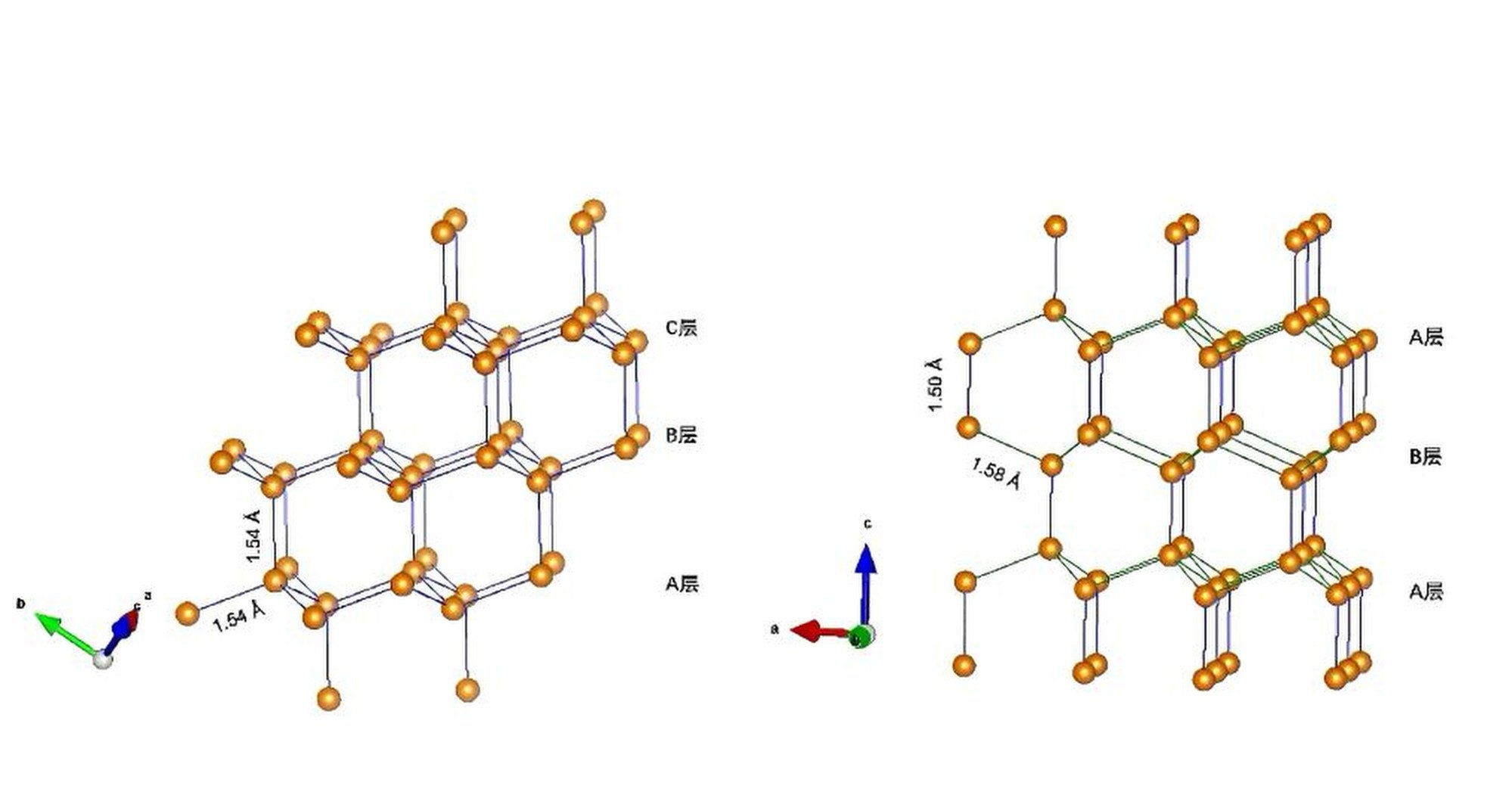
A significant breakthrough has been made in the field of materials science, as researchers in China have successfully recreated a rare form of diamond known as the "hexagonal-structured diamond" in a laboratory setting. This achievement marks the resolution of a long-standing debate about the material's existence and opens up new possibilities for advancements in various industries, including defense and electronics.
The first hexagonal-structured diamond was discovered in 1967 within the Canyon Diablo meteorite that struck Arizona approximately 49,000 years ago. Scientists believed that this unique structure formed from graphite under the extreme heat and pressure generated by the meteorite's impact with Earth. While all diamonds are composed of carbon atoms, they can take on different structural forms, such as the well-known cubic structure. However, the hexagonal variant has remained elusive, with many researchers struggling to recreate it in a controlled environment.
A New Era in Diamond Synthesis
In an article published on July 30 in the peer-reviewed journal Nature, Chinese researchers detailed their successful creation of high-purity hexagonal diamond crystals measuring 100 micrometres in size. This breakthrough provides definitive proof of the material's macroscopic existence and represents a major step forward in the field.
The research team, comprising experts from the Centre for High Pressure Science and Technology Advanced Research and the Chinese Academy of Sciences' Xian Institute of Optics and Precision Mechanics, overcame previous challenges that had hindered the synthesis of pure hexagonal structures. According to Luo Duan, the paper's corresponding author, earlier attempts typically resulted in cubic diamonds or mixed-phase samples rather than the desired hexagonal form.
Luo, a professor at the Xian institute, explained that previous hexagonal diamonds were often nanoscale in size, thousands of times smaller than the current results. These smaller versions were typically produced through impact synthesis or as miniature particles, which limited their practical applications. The Chinese team’s innovation, however, offers the potential for international patent barriers, paving the way for future technology transfer and industrialization.
Potential Applications and Properties
The hexagonal diamond structure is expected to offer superior hardness and thermal properties compared to traditional cubic diamonds. Its potential applications span multiple fields, including cutting tools, superhard abrasives, high-performance electronic devices, quantum technology, and high-efficiency heat dissipation systems.
According to Luo, the hexagonal diamond is a structural variant of the cubic version, sharing similar mechanical, thermal, and optical properties while surpassing them in certain aspects. The material's performance data shows that it rivals premium natural diamonds in hardness, reaching 110 gigapascals, while exhibiting greater compressive strength and impact resistance.
Additionally, the hexagonal diamond demonstrates a thermal conductivity five times higher than copper, maintaining structural stability at temperatures up to 1,100 degrees Celsius—far exceeding conventional semiconductor cooling materials. The material's non-uniform anisotropic structure could also lead to piezoelectric and ferroelectric properties, potentially powering quantum sensors and high-frequency devices in the future.
Pathways for Future Development
Luo from the Xian institute stated that the team's synthesized samples already meet industrial manufacturing standards for ultra-cutting and wear-resistant materials. However, the researchers are now working on creating larger, higher-quality samples for practical applications. To achieve this, they will need to optimize synthesis conditions and explore nanocrystal engineering, among other techniques.
Mao Ho-kwang, a fellow author from the research centre, emphasized that the material could pioneer new pathways for developing ultra-hard materials and advanced electronic devices. He highlighted that the hexagonal diamond has been predicted to possess favorable mechanical, electrical, thermal, and optical properties comparable and complementary to cubic diamonds.
This breakthrough not only resolves nearly 70 years of debate about the structure and formation of hexagonal diamonds but also sets the stage for future innovations in materials science and technology. As researchers continue to refine their methods, the potential applications of this unique material are vast and promising.