
The Legacy of Loss and Memory
As the 80th anniversary of the U.S. atomic bombing of Nagasaki approaches, a 93-year-old survivor shares his poignant reflections on the lives of his classmates who perished just four months after starting junior high school. This memory is central to his preparation for this summer's memorial ceremony, where he continues to honor those lost in the tragedy.
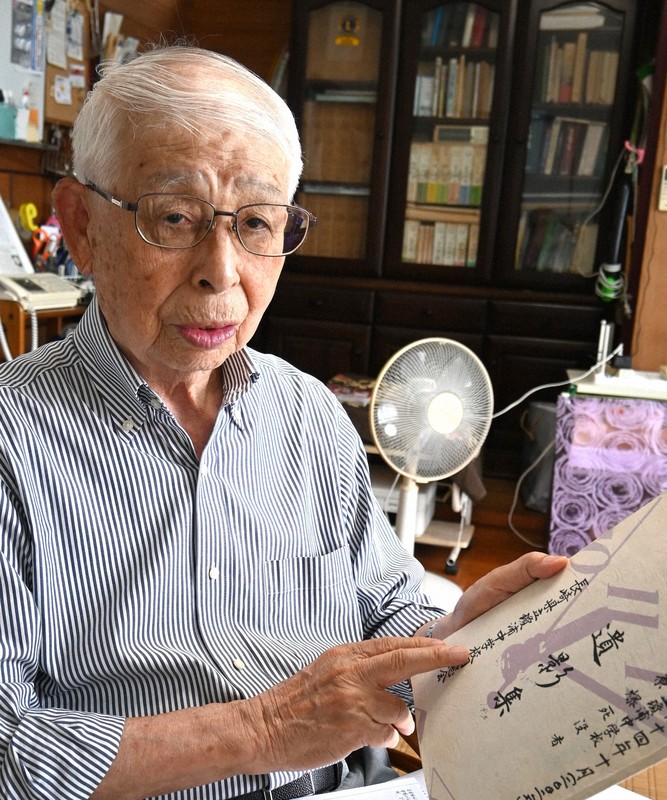
The estimated death toll from the atomic bombing on August 9, 1945, by the end of that year is about 70,000. However, these figures are based on estimates due to the loss of administrative records and the tragic fact that many families were entirely wiped out. For Kazuo Maruta, the experience remains deeply personal. At 13 years old, he was a first-year student at the former Nagasaki Prefectural Keiho Junior High School when he was exposed to radiation from the atomic bomb. He now holds a list of 299 names of first-year students, documenting their fates after the bombing, including immediate deaths and other causes. Of these, 114 were victims of the atomic bombing. This list was created by their homeroom teacher shortly after the bombing and has been carefully preserved by Maruta.
On the day of the bombing, Maruta had returned home around 10:50 a.m. after finishing his English final exam. While wiping sweat from his bare upper body, he heard the sound of a B-29 bomber and was struck by a blue-white flash. He was about 1.3 kilometers south of the hypocenter. The experience felt like being dragged through a pitch-dark tunnel. When he regained consciousness, he found himself trapped under his house, hearing someone outside shouting, "There's a fire!" He managed to escape, only to find glass embedded in his back, leaving him covered in blood.
He learned from a neighbor that his mother, Matsue, had died instantly while talking in front of a neighbor's house. Two years after losing his father to illness, he lost his mother as well. Maruta fled to the hillside behind his house, where he was drenched by heavy black rain. That night, diarrhea set in, and by morning, he realized he had bloody stools. An uncle he met by chance helped him evacuate to the city of Isahaya, about 20 kilometers away, by train on August 11. At a first aid station set up at an elementary school, a doctor, unaware of acute radiation syndrome, diagnosed him with "dysentery" upon seeing the bloody stools. After treatment at a hospital, he returned to school in November.
The school building of Keiho Junior High, located about 800 meters south of the hypocenter, was completely destroyed. Of the approximately 1,200 students, around 400 perished, including Maruta's classmates and higher-grade students who had been mobilized to work in military factories.
After the war, Maruta graduated from high school and became a police officer. About 30 years ago, upon retirement, he began sharing his experiences as a hibakusha, or an A-bomb survivor. This year, at 93, he has already given over 20 talks to groups including students on school trips. "Losing my classmates just four months after starting school is the foundation of my storytelling," he said. Maruta is also a member of the Nagasaki Foundation for the Promotion of Peace's photo material research committee, examining photographs that document the aftermath of the atomic bombing.
As a caretaker of Keiho Junior High's Suiran-kai, the successor organization to the school's alumni association which disbanded in 2011, Maruta organizes an annual memorial service on August 9. However, the aging of alumni and bereaved families has led to dwindling attendance. "How regretful my classmates must have felt. We must not forget them. We must continue to tell their story," Maruta insists. This year, he once again handwrote the names on each invitation postcard for the memorial service.
The Decline of Hibakusha Numbers
As of the end of March 2025, the number of holders of atomic bomb survivor's certificates totaled 99,130, falling below 100,000 for the first time since the issuance system began. This is just over a quarter of the peak number of 372,264 recorded in fiscal 1980. The average age of certificate holders stood at 86.13 years. By prefecture, Hiroshima had the highest number at 48,310, followed by Nagasaki at 23,543, Fukuoka at 3,957, Tokyo at 3,307 and Osaka at 3,186. Yamagata Prefecture had the fewest, with six holders. There were also 2,178 "overseas hibakusha" — A-bomb survivors who returned to their home countries or emigrated abroad after the war.