
EU Sanctions on India: Symbolic or Significant?
The European Union's recent sanctions against India have sparked discussions about their potential impact on bilateral trade relations. While the move is seen as symbolic, experts argue that the real challenge for New Delhi lies elsewhere—specifically, in the looming threat of US tariffs on Indian goods.
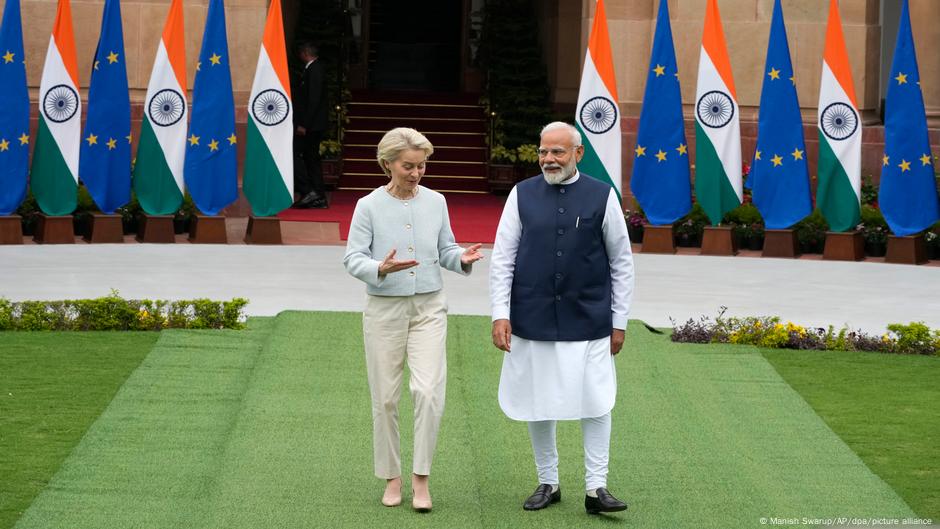
The year started with optimism for the EU-India relationship when European Commission President Ursula von der Leyen visited New Delhi in February and worked alongside Indian Prime Minister Narendra Modi to resolve outstanding issues and advance a long-delayed free trade agreement. However, this momentum was disrupted in July when India became part of the EU's 18th sanctions package targeting Russia. The measures specifically target India's refining of discounted Russian crude oil and its export of these products, some of which are sold in Europe.
Despite these developments, many experts believe the EU's sanctions will not derail the potential trade deal. Instead, they argue that the more pressing concern for India is the possibility of the United States imposing tariffs of up to 50% on Indian goods. This threat could actually work in the EU’s favor, as it may encourage India to seek alternative trade partners.
Understanding the EU's Sanctions
As part of its efforts to cut off funding for Russia's war in Ukraine, the EU has banned imports of refined petroleum products from Russian crude. This ban applies to any third country, including India. As a result, the EU sanctioned Nayara Energy, an Indian refinery partially owned by Russian energy giant Rosneft. This marks the first time the EU has designated a flag registry and a major Rosneft refinery in India.
Nayara Energy responded by calling the move hypocritical, pointing out that many European countries continue to import Russian energy through various channels. The company argued that the sanctions target an Indian asset processing Russian crude primarily used by India's domestic population and businesses.
However, experts suggest that the EU's actions are largely symbolic and unlikely to significantly affect India's energy trade or exports. Garima Mohan of the German Marshall Fund of the United States noted that the EU's sanctions lack enforcement power and that India could easily pivot to other sources, such as Iraqi oil.
Jacob Funk Kirkegaard, an economics expert at the Brussels-based Bruegel think tank, agreed, stating that while the EU's move is an escalation, it won't harm trade negotiations. He emphasized that the greater pressure on India currently comes from the United States.
US Tariffs and the Path to EU-India Trade
With the absence of a trade agreement between the US and India, the situation has created an opportunity for the EU to strengthen its ties with New Delhi. Experts believe that the threat of high US tariffs on Indian goods could push India to seek closer economic partnerships with the EU.
Kirkegaard highlighted that India's desire to diversify away from the US has increased, particularly given the unpredictable nature of US trade policies under previous administrations. Mohan echoed this sentiment, suggesting that the shift in India-US dynamics could ultimately benefit the EU.
The EU's approach to trade negotiations, especially in the agricultural sector, is also seen as a key factor. With agriculture employing nearly 44% of India's population, there are concerns about job losses if India opens up more to foreign competition. The EU, however, is understood to be more sensitive to these issues than the US, making it a more favorable partner for India.
Geopolitical Implications and Future Prospects
If India were to reduce its purchases of Russian oil to avoid US tariffs, it could potentially reduce a key revenue stream for Moscow, aligning with EU and Ukrainian interests. However, an Indian diplomat warned that removing Russian oil from the global supply could lead to price spikes, affecting everyone involved.
While the EU's designation of Nayara Energy is unlikely to influence Putin's calculations, it could impact India's decisions, which may depend more on Washington than Brussels. Despite the setback in EU-India relations, the overall momentum toward a trade agreement remains strong.
What began as a promising year for EU-India ties could still lead to a breakthrough, especially if shifting geopolitical dynamics bring New Delhi and Brussels closer together.