
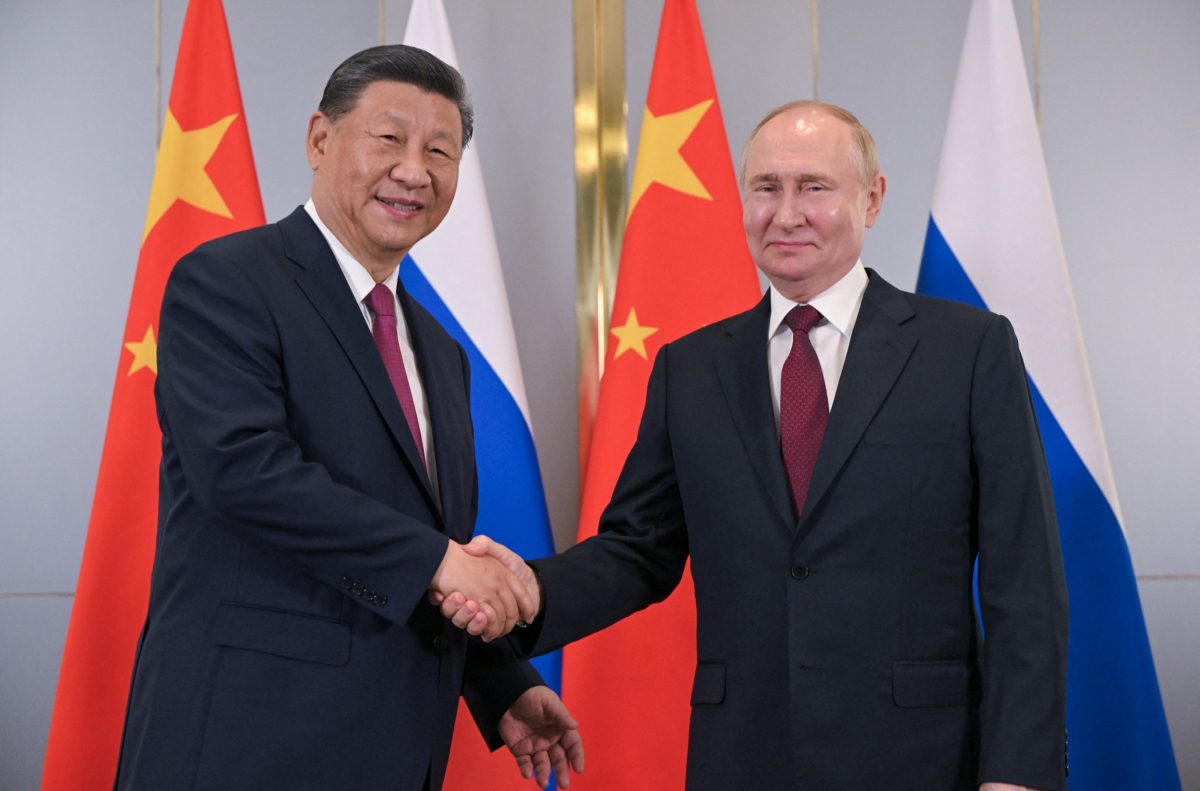
China’s Potential Strategy: Coordinating with Russia to Distract NATO
The head of the North Atlantic Treaty Organization (NATO) has raised concerns that China could potentially ask Russia to launch an attack on a NATO member state as a way to divert attention from its own planned invasion of Taiwan. This warning comes from NATO Secretary General Mark Rutte, who suggested that if Chinese President Xi Jinping were to consider an attack on Taiwan, he would likely coordinate with Russian President Vladimir Putin first.
According to Rutte, “he would first make sure that he makes a call to his very junior partner in all of this, Vladimir Vladimirovich Putin… telling him, ‘Hey, I’m going to do this, and I need you to keep them busy in Europe by attacking NATO territory.’” This statement was made during an interview with The New York Times.
But how plausible is such a coordinated attack? Experts have varying opinions on the likelihood of this scenario unfolding.
China’s Stance on Taiwan
China views Taiwan, a democratically governed island, as part of its territory and has repeatedly emphasized the concept of “inevitable reunification,” including the possibility of using force if necessary. Beijing has been increasing its military presence near Taiwan, with heightened activity over the past year. In May, U.S. Defense Secretary Pete Hegseth warned that a Chinese military attack on Taiwan could be imminent.
Admiral Samuel Paparo, head of the U.S. Indo-Pacific Command, also highlighted that the Chinese military is working toward achieving readiness by 2027 to potentially take Taiwan by force. While some experts believe that a long-planned coordinated attack between China and Russia is unlikely in the near term, the possibility of opportunistic actions remains a concern.
Expert Opinions on Coordinated Attacks
Dr. William Matthews, a senior research fellow at Chatham House, stated that a coordinated attack is “highly unlikely” because China has so far been cautious in its approach to avoid all-out war. He noted that China's current strategy involves escalating pressure without crossing into full-scale invasion, which it would likely continue as long as possible.
Matthews added that starting a war with Taiwan could risk a conflict with the United States, something China would want to avoid. Additionally, initiating a war with NATO would be even less favorable for China, given the potential consequences.
However, Dr. Sidharth Kaushal of the Royal United Services Institute pointed out that while a pre-planned attack may not be likely, Russia might still act opportunistically if a conflict arises elsewhere. He emphasized that even without a formal alliance, the idea of China and Russia merging their threats should be considered.
The Relationship Between China and Russia
The British Army has identified China and Russia as two of the most significant threats to the UK, noting their growing cooperation with Iran and North Korea as part of an “axis of upheaval.” Since the 1990s, China and Russia have maintained close defense ties, with China playing a key role in enabling Russia’s military operations in Ukraine through trade and technology support.
Despite this cooperation, there is no formal alliance between the two countries, and their collaboration has limitations. For example, China has not sent troops to assist Russia in Ukraine, unlike North Korea, nor has it provided direct military equipment like Iran.
Kaushal explained that a Chinese conflict in Asia could draw significant American military resources to the Pacific, creating gaps in European deterrence that Russia might exploit. This scenario highlights the importance of NATO planning for the possibility of a simultaneous attack.
Risks of a Two-Front War
A coordinated attack by China and Russia would represent a global conflict with severe consequences. According to Matthews, such a scenario would risk nuclear Armageddon and cause massive damage to China’s carefully cultivated economic relationships. He noted that China would likely seek to avoid escalation beyond the region, aiming to prevent U.S. intervention.
Kaushal warned that a dual conflict would create immense stress for NATO, particularly if the U.S. were drawn into the Indo-Pacific theater, leaving Europe vulnerable. He emphasized that the U.S. plays a critical role in providing air and missile defense capabilities, which would be crucial in resisting mass attacks.
Economic Consequences of Conflict
The economic impact of a war involving both China and Russia would be catastrophic. Kaushal highlighted that such a conflict could lead to irrevocable damage to the global economy, with potential shortages of medicines, disruptions to phone networks, and blocked shipping routes. A study suggested that the U.S. economy could contract by around 17%, while East Asian economies, including China’s, could face a 35% contraction.
Combining this with a conflict in Europe, which would already suffer from the effects of the Asian conflict, could lead to a global economic collapse. Despite these risks, Kaushal believes that China might still initiate a conflict if it perceives a quick victory or feels desperate due to the threat of Taiwan seeking de jure independence.