
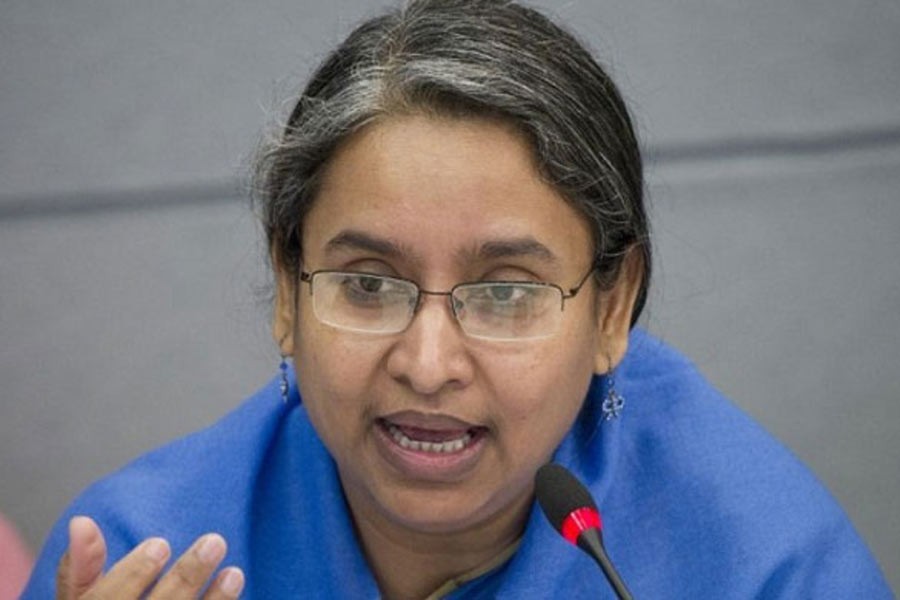
A former Minister of Education, Professor Ruqayyatu Ahmed Rufa’i, has advocated for innovation in curriculum development as provision of equitable access to education at all levels in the country.
She said this at an international symposium held in her honour, entitled, ‘Tackling Grand Challenges in Education in Africa in the Context of Emerging Technologies via Zoom.’
Rufa’i who served as Nigeria’s of education minister between 2010 and 2013 reaffirmed her lifelong commitment to improving education across Africa, despite retiring from public service after more than three decades of impact in teaching, policy making, and administration.
She described her retirement as a transition into global educational advocacy rather than a withdrawal from public life.
She renewed her call for equitable access and quality education, noting that this would continue to define her post-retirement engagements. “My decision to retire early is not because I am tired, but rather to explore further avenues for service to the global community,” she said.
Her remarks highlighted a distinguished career at Bayero University, Kano (BUK), where she mentored students and influenced education policy. Her earlier roles as Jigawa State Commissioner for Education and Federal Minister of Education were also cited as pivotal to national reforms.
Appointed Minister of Education of Nigeria in 2010, she had an eventful three-year tenure during which she initiated the ‘One-Year Strategy and four-Year Strategic Plan’ for the Development of the Education Sector which focused on key areas of Access, Quality, Teacher Education, Funding, Technical and Vocational Education.
There were also boosts to the Basic and Secondary Sector through the Almajiri Education and Boys Drop-Out Programmes. She similarly pursued the amendment of the Education Tax Act such that the Tertiary Education Trust Fund (TETFund) now focuses exclusively on the development and rehabilitation of infrastructure and human resources in the country’s higher education sub-sector.
As far back to her days as Education Commissioner in Jigawa State, Professor Ruqayyatu Ahmed Rufa’i has demonstrated deep passion for the education of the Girl-Child and often challenged the outdated notion that female children did not need to go to school as they will end up in the kitchen, as it were.
Her contributions to the education sector span decades, marked by passionate advocacy for girl-child education, equitable access to learning, and the modernisation of Africa’s educational systems.
Her tenure as minister was known for bold reforms, inclusive policies, and the promotion of innovation in curriculum development and teacher training.
Speakers at the symposium, including education scholars and policymakers, praised her dedication to using technology to expand access and inclusion in African education systems.
In his remarks, former Executive Secretary, National Universities Commission (NUC), Professor (Emeritus) Peter Okebukola, described her as a “visionary reformer” whose leadership modelled how policy can drive measurable outcomes.
In his presentation, vice chancellor of Accra Metropolitan University, Professor Goski Alabi, described Professor Rufa’i as a beacon of hope and transformational leadership in Africa’s education sector.
She commended the honouree for her unwavering commitment to equity, excellence, and empowerment, particularly for women and young people.
Professor Goski’s presentation addressed the transformational potential of emerging technologies in African education, urging stakeholders to embrace innovation not just as a tool, but as a catalyst for inclusive and sustainable development.
ALSO READ: Ladoja to be crowned 44th Olubadan on Friday, September 26
She emphasised the importance of flexible learning models to accommodate diverse learners across the continent, the integration of Artificial Intelligence, Virtual Reality, and 5G technologies in classrooms, and the need to re-imagine curricula to meet global standards while preserving African values and heritage.
She also spoke about building institutional capacity to ensure both educators and learners are prepared for the digital future.
In her words, “Emerging technologies must not widen the gap in access – they must bridge it. The real challenge lies in how we deploy these tools to ensure no one is left behind.”
The event was not just a celebration of one woman’s legacy but a rallying call for a united front in tackling Africa’s pressing educational challenges.
Professor Goski Alabi reaffirmed her commitment, through Accra Metropolitan University, to champion leadership, innovation, flexibility, and entrepreneurship in education.
She ended her remarks with a note of gratitude: “It is both an honour and a responsibility to be part of the generation that carries forward the torch lit by pioneers like Professor Rufa’i.
“We will continue to build the Africa they dreamed of one student, one innovation, one policy at a time.”
The event brought together key thought leaders to reflect on Africa’s educational journey and the road ahead, particularly in adapting to the fast-evolving technological landscape. Most experts from across Africa and beyond stressed the need to harness Artificial Intelligence (AI), strengthen Science, Technology, Engineering, and Mathematics (STEM) education, and develop a continental policy for technology use in schools, reflecting themes consistent with Professor Ruqayyatu’s legacy.
WATCH TOP VIDEOS FROM NIGERIAN TRIBUNE TVLet’s Talk About SELF-AWARENESS Is Your Confidence Mistaken for Pride? Let’s talk about it Is Etiquette About Perfection…Or Just Not Being Rude? Top Psychologist Reveal 3 Signs You’re Struggling With Imposter Syndrome Do You Pick Up Work-Related Calls at Midnight or Never? Let’s Talk About Boundaries Provided by SyndiGate Media Inc. (Syndigate.info).