
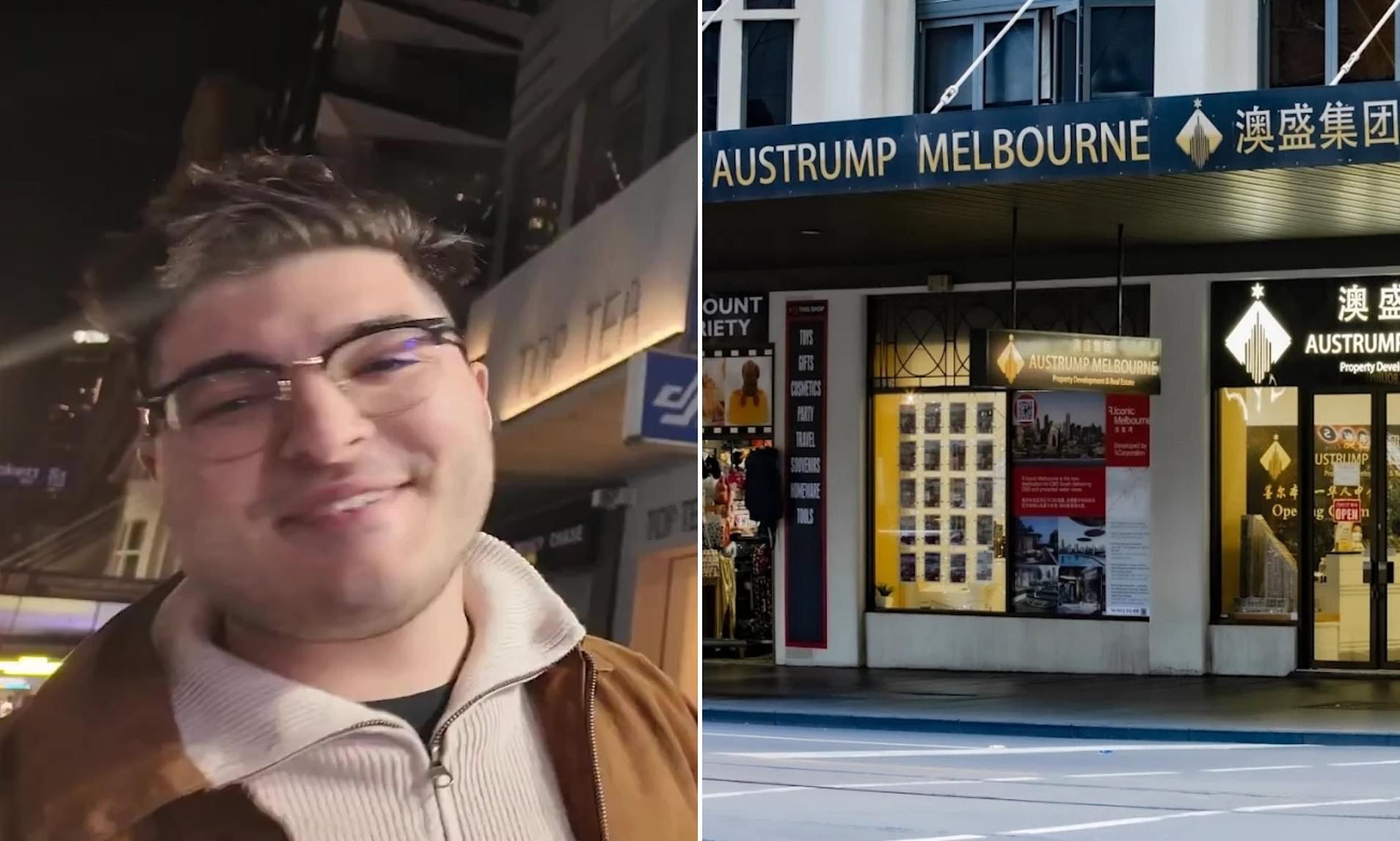
A Controversial Claim About Chinese Real Estate Firms in Melbourne
A former Brisbane student has sparked a heated debate by claiming that several Chinese-owned real estate firms in Melbourne are excluding English-speaking Australians. Drew Pavlou, who describes himself as a "Western civilisation enjoyer," documented his findings during a visit to Melbourne’s Swanston Street and Elizabeth Street, two of the city's main shopping thoroughfares.
Pavlou shared his observations on social media, where he claimed to have identified 12 Chinese real estate agencies within a short stretch of these streets. According to him, most of these businesses advertise exclusively in Chinese, targeting overseas buyers rather than local English speakers. He argued that this practice is harming Australia’s housing market, which is currently facing its worst crisis in history.
"In the full video I published on YouTube, I counted 15 bubble tea stores and about 12 Chinese real estate firms within a 500-meter stretch," Pavlou said. "They only advertise in the Chinese language for Chinese people to buy property in Australia. It was just beautiful."
The Australian emphasized that his video was not racially motivated, noting that his family background is Greek-Australian. He stated that he would oppose any real estate agency, regardless of its origin, that advertised solely to overseas buyers. His concern centers on the fact that young Australians are struggling to enter the housing market due to record-high prices and limited supply. Meanwhile, prime properties are being marketed directly to offshore buyers who may never live in Australia, potentially driving up demand and putting pressure on local families and first-home buyers.
Pavlou pointed out that one of the real estate agencies featured in his video, Nord International, had no English-language advertising in its shop window. This observation became a focal point for the controversy surrounding his claims.
Public Reaction and Criticism
The video received mixed reactions from viewers. Some criticized Pavlou for filming in an area known for its high concentration of Chinese businesses. One person wrote, "You're literally walking through Chinatown, of course there's going to be Chinese restaurants. It would be like counting every Italian restaurant in Lygon Street or Pho Place in Springvale." Others echoed similar sentiments, suggesting that it was expected to see Chinese businesses in a neighborhood like Chinatown.
In response, Pavlou clarified that while he was near Chinatown, he was actually on Swanston Street and Elizabeth Street, which intersect with Little Bourke Street, the heart of Melbourne’s Chinatown. He also noted that he had previously staged a year-long protest at the University of Queensland against Beijing's actions in Hong Kong, highlighting his broader concerns about foreign influence in Australia.
Responses from Real Estate Agencies
Several real estate agencies featured in Pavlou’s video responded to the allegations. A spokesperson for Elite Real Estate, which was included in the footage, stated that all their listings were advertised in English and that their multilingual team worked with clients from diverse backgrounds.
Kristy Zhang, director and co-founder of Austrump Hosting, another agency mentioned in the video, said her business serves a "diverse client base." She added that while they occasionally use Chinese language materials to assist clients who prefer it, they regularly produce and distribute all marketing materials, including flyers and brochures, in English.
Broader Implications
The debate highlights a growing concern about the impact of foreign investment on Australia’s housing market. While some argue that international buyers bring capital and boost property values, others believe that such practices exacerbate affordability issues for local residents. The situation raises questions about how real estate agencies should balance their marketing strategies to serve both domestic and international clients effectively.
As the discussion continues, it remains to be seen whether the issue will lead to policy changes or increased scrutiny of foreign investment in the Australian real estate sector. For now, the controversy underscores the complex relationship between globalization, local communities, and housing affordability.