
A high-level committee suggested to concentrate on artificial intelligence (AI) might assist technology startups in Hong Kong in overcoming legal and political obstacles, as well as obtain access to crucial databases for training models, according to market leaders.
However, experts also informed the South China Morning Post on Thursday that the committee, which was introduced in the most recent budget and will be headed by the city's finance director, must include a wide range of specialists and be "results-oriented" to swiftly respond to the rapidly changing industry.
Legislator William Wong Kam-fai, also serving as a professor in computational linguistics, mentioned that he anticipated the committee would "demolish barriers" and accelerate the approval of financial support, providing quicker assistance to the industry.
Are you curious about the most significant issues and developments happening globally? Find the solutions withSCMP Knowledge, our latest platform featuring curated content including explainers, FAQs, analyses, and infographics, presented by our acclaimed team.
Companies in Hong Kong utilizing artificial intelligence will require significantly greater computational resources and improved algorithms to manage large volumes of data efficiently," he stated. "For instance, additional companies might be permitted to access supercomputing facilities.
Wong was mentioning the Cyberport's own supercomputing facility, which became operational in December 2024.
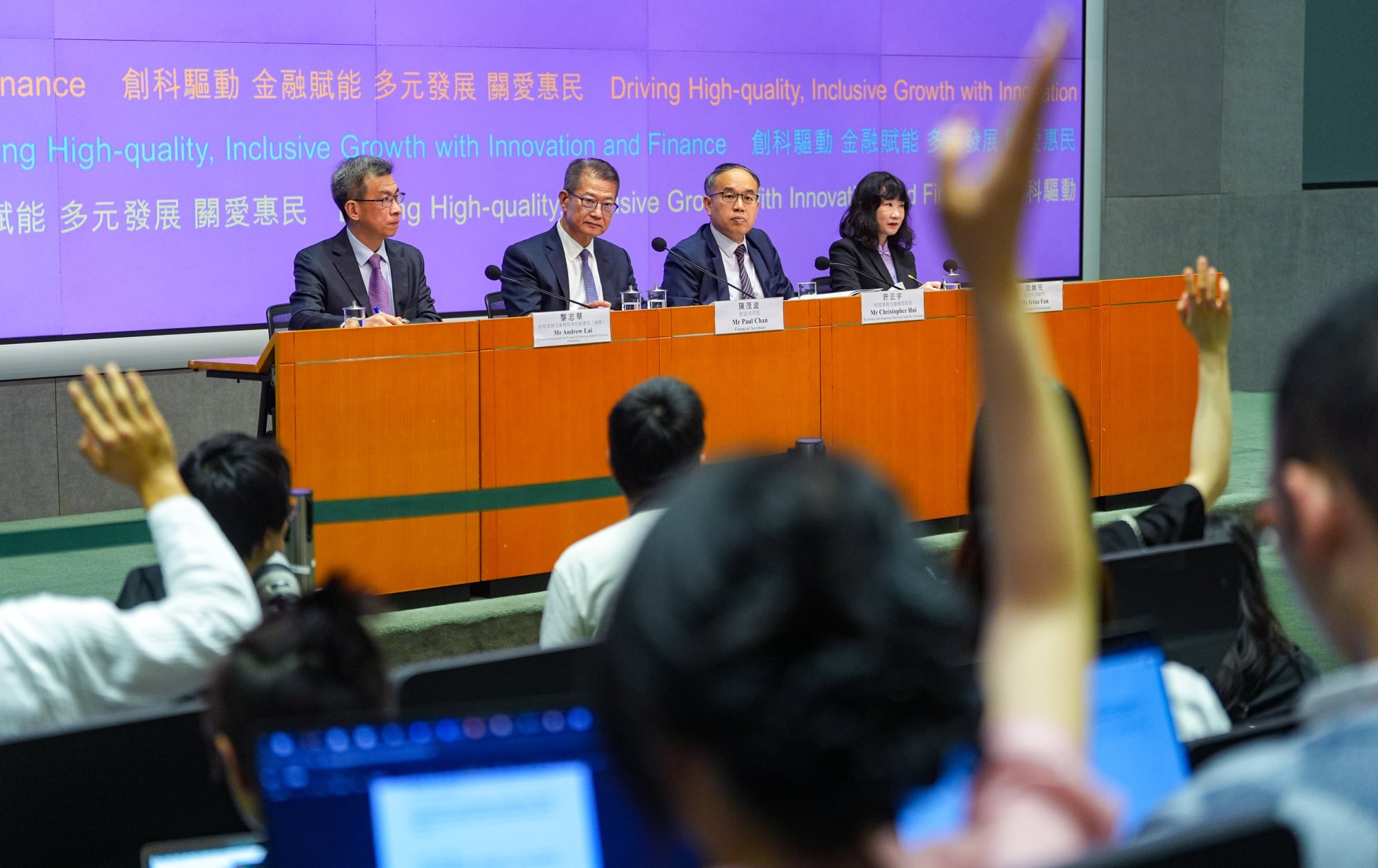
In Financial Secretary Paul Chan Mo-po'sbudget speechOn Wednesday, he committed to forming and leading the "Committee on AI+ and Industry Development Strategy," which will develop approaches and foster an environment conducive to industrial change.
The panel will consist of scholars and other specialists, along with delegates from businesses and companies located in industrial parks.
It will first concentrate on life and health technologies and "embodied AI," a term referring to AI integrated into physical systems like robots or gadgets that can interact with their environment.

The city's advantage in research and development (R&D) has positioned it as a prime location for innovations, according to Sun Dong, the Secretary for Innovation, Technology, and Industry.
He stated, 'Hong Kong has unique strengths in various areas.' 'We have obtained significant research results in diagnostics, treatments, and elderly care.'
The government sought to improve public understanding of artificial intelligence, he mentioned, adding that in the context of the larger effort to incorporate the technology, each project was being considered a key focus.
Samuel Lam Hon-yuen, the CEO of drone show company X Social Group, stated that he felt the committee could have a significant role in facilitating discussions among various parties to improve the environment for product commercialization.
He also advocated for increased representation in industry committees.
Previously, some key committees were largely led by highly academic individuals," Lam stated. "However, the AI industry is advancing at a very rapid pace and urgently requires insights from professionals in various sectors — including business, commerce, academia, and research.
Michael So Chung-shing, the founder of the Artificial Intelligence Application Research Society, also known as the AiX Society, highlighted that the industry is subject to rapid changes and underlined the significance of agility for the committee.
He mentioned that the committee had to go beyond merely "talking shop," but also noted that finance chief Chan's position as chairman could foster greater unity within the industry, while also assisting in overcoming departmental divisions and efficiently allocating resources.
"The committee should consist of professionals who are actively involved in the market's frontline and create a quick-response system to convert the most recent global technological advancements, like embodied AI, into policies suitable for Hong Kong," he stated.
We must be capable of swiftly drawing in top companies and offering them practical applications to gain a competitive edge.
Legislator Wong pointed out major regulatory challenges in promoting life and health technology, as well as embodied AI.
"He proposed that the government might utilize the committee to organize regulatory sandboxes in the future," he explained, noting that these efforts would collect industry insights from various use cases to assist in updating legislation and tackle safety and legal issues.
Roy Lim Long-hei, the founder of Robocore Technology, a robotics firm that has recently secured a US$30 million investment from Foxconn Technology, expressed his hope that the committee would incorporate specialists from various fields, including healthcare and education, as well as university students.
The committee might also assist companies in addressing issues via top-level discussions and cooperation, he mentioned.
Several AI platforms in the United States have restricted access to Hong Kong," he mentioned. "There are numerous databases that we are unable to reach.
We have the opportunity to collaborate with other cities or nations to engage in discussions, and for instance, exchange data from China's DeepSeek with the US' ChatGPT. This could genuinely benefit humanity.
The artificial intelligence technology created by Lim's company is also not adequately safeguarded by current intellectual property regulations, a challenge he believes legal specialists on the committee can address.
"Due to the swift advancement of the sector, over 50 AI products are released daily around the world, which is staggering," he mentioned.
Assisted by the universities, which possess the capabilities to test for flaws, the committee was able to develop a definitive list of AI functions that are suitable for use across various sectors.
Lam, a drone display operator, mentioned that Hong Kong faces challenges in establishing robust AI research and development environments because of its small market and dependence on talent from mainland China or abroad.
However, the city held a benefit as it combined Eastern and Western elements.
"Hong Kong features unique application scenarios that combine Chinese and Western elements, serving as an excellent gateway for companies to 'go global," Lam stated.
His organization was evaluating a safety metric for the low-altitude economy, considering elements like weather conditions for drone activities at particular times and places.
This index might not attract much attention from investors on the mainland," he stated. "However, by testing and earning market recognition within Hong Kong's intricate urban setting, we can subsequently introduce the product to a global audience.
The establishment of a high-level AI panel in Hong Kong represents a meaningful step toward strengthening the city’s innovation ecosystem, but its effectiveness will ultimately depend on execution, inclusiveness, and adaptability. As market leaders and experts have emphasized, AI startups today face not just technological hurdles but also complex legal and geopolitical challenges — including issues around data access, intellectual property, and regulatory transparency — that could significantly slow down innovation and commercialization if left unaddressed.
By proposing a committee that includes diverse voices from academia, industry, research, and private enterprise, policymakers acknowledge that AI is not solely a technical problem but a multidimensional economic and legal issue demanding coordinated solutions. Such a panel could help streamline funding approvals, support access to advanced resources like supercomputing facilities, and create regulatory “sandboxes” that balance innovation with safety.
However, converting this committee into an action-oriented body with real influence rather than a symbolic advisory group will be critical if Hong Kong wants to retain and attract cutting-edge start-ups. In a region where innovation ecosystems are rapidly advancing — boosted by government schemes, funding support, and international collaborations — the panel could serve as a catalyst for growth, but only if it remains responsive, well-resourced, and closely aligned with industry needs.