
The Vibrant Ceremonies of the Sango Festival in Oyo Town
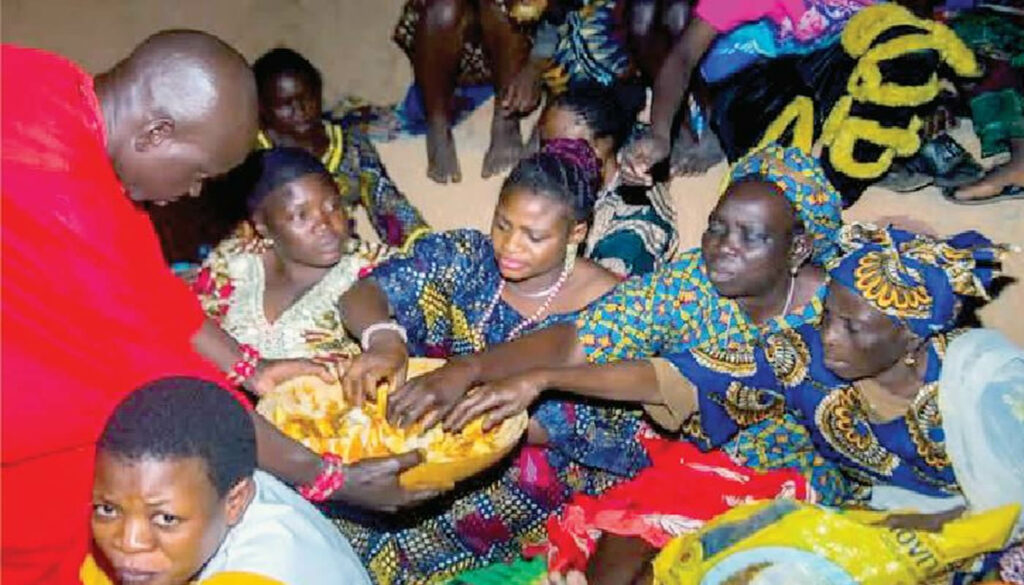
The annual Sango festival in Oyo Town, Oyo State, is a vivid celebration of ancient Yoruba traditions that continues to shape lives and communities. This 10-day event, held every August, begins on New Year’s Eve according to the Yoruba indigenous calendar. On the first day, the Mogba Sango (Sango priest/chief head) prepares a ritual meal to honor Sango, the formidable Orisa of thunder and lightning. The aroma of freshly boiled yams fills the air as the priest, adorned with beaded necklaces and bracelets, slices through the tubers and drizzles red palm oil over them.
This sacred meal is shared among attendees gathered at the Ojubo Sango Koso, where Pa Oyedemi Oyelowo, dressed in a deep red native ensemble, carries the delicacy towards the temple. His wrists are adorned with gleaming red beads, while his head is cleanly shaven, symbolizing his spiritual connection to Sango. Outside the shrine, Fuji music blares, creating a festive atmosphere for hundreds of attendees from across the state and country.
New Year’s Eve, known as Aisun Koso, is marked by rhythmic drumbeats, graceful dances, and unrestrained delight. In this ancient town, the celebration transcends mere festivity; it is steeped in layers of history and spiritual reverence, echoing the enduring legacy of Sango in every beat, step, and chant.
According to Sangokayode Ibuowo, a Sango high chief priest, the new year begins with the start of a new 13-month cycle when the new yam is given to Sango. From January to June, when new yams are harvested, they are prohibited from being eaten until they have been cut for Sango. Only old yams are consumed during this period.
The Sango festival kicked off on the morning of last week’s Thursday with Ogun Ajobo, a ceremonial rite involving prayers to the patron of iron and divination at Idi Ogun, the palace of the 46th Alaafin of Oyo, Oba Abimbola Owoade. The 10-day event includes various rites such as chanting, storytelling, drumming, and dancing. It concludes on Saturday with Ija Ki Naa, a grand finale featuring traditions, magic performances, and pulsating cultural energies.
Renamed as the World Sango Festival by the Oyo State Government in 2013, the festival gained global recognition in 2023 when the United Nations Educational, Scientific and Cultural Organisation listed it as part of the Intangible Cultural Heritage of Humanity.
The Selection of the Elegun Sango Oyo
At the stroke of midnight, as the festival entered the second day (Koso Day), the new Elegun Sango Oyo, Sangoponle Ibuowo, was selected. This announcement was greeted with fervent chants of “Kabiyesi Sango o!” from the ecstatic crowd. According to Isese practitioners, elegun are individuals permanently and spiritually possessed by an orisa, such as Sango, Yemoja, Oya, or Obatala.
Sangoponle is one of the biological sons of the late Elegun Sango, and the Ibuowo family is among those from which an Elegun Sango in Oyo is traditionally selected. A babalawo explained that the Elegun Sango Oyo is chosen through a sacred system of divination using 16 cowrie shells. Once selected, he is believed to embody and represent the orisa on earth.
During the festival, the Elegun will personify the divinity, dressed fully in Sango’s attire and exercising spiritual powers to bless Oyo Town. The Alaafin will temporarily leave the palace during this performance because he must not see Sango Koso while on his throne. The only time he is allowed to see Sango Koso is during his coronation.
Honoring Yemoja and Other Orisas
On the third day of the Sango festival, traditionalists dressed in white attire, with some having green and blue-coloured girdles tied around their waists, gathered at the banks of the Ogun River in Oyo to honor Yemoja, revered as the “mother of all Orisas.” During the ceremony, the Arugba of Yemoja carried symbolic offerings covered with a green cloth and made a slow procession to the river’s edge. There, the Yemoja Priestess, adorned with sacred beads, made supplications at the river using cowrie shells.
Sango, arguably the most popular orisha in Yoruba indigenous spirituality, is also worshipped among the Edo and Fon people. He is revered both as a deified ancestor and a natural force, with both aspects associated with priesthood and the authority of the Oyo throne. As a royal ancestor of the Yoruba, Sango is said to have been the third or fourth Alaafin of the Oyo Empire, succeeding Oranmiyan and Ajaka before his posthumous deification.
The Sacred Shrine and Its Significance
On the fourth day of the Sango festival, when the New Year divination was to be held, our correspondent visited the historic old Koso Shrine. The temple, believed to be where Sango’s divine energy still resides, was officially registered by the state government as a recognized prayer ground in 2020. Nestled in a quiet community, the shrine stands as a long, rectangular building with a low, sloping roof of corrugated iron sheets weathered by time.
Inside, the left wing of the shrine’s walls is adorned with paintings of white cowrie-shell paintings and red carvings of sacred objects such as the Bata drum, laba, sere, and a double-bladed axe. A door veiled with a red curtain leads to the inner sanctuary, a sacred space accessible only by the Mogba, Yaye (Alaafin’s high chief), and Alapinni (Egungun high chief).
The Role of the Bata Drum and Physical Signs
Interspersing his narration with quotes from Ifa, the Awise Adosu Sango further clarified Sango’s affiliation with the Bata drum. Babalola added, “Bata is very close to Sango because it’s an Orisa like Sango. Bata rescued Sango from certain dangers.” Citing oral traditions, he recounted how Sango went into exile because of his anger, but when the spiritual elders sought who was closest to him, they realized it was Bata.
When asked about the physical signs that a person is taken over by Sango’s energies, Babalola responded, “From that point on, you will see that the person’s eyes will turn red. His bones will become stronger, and he could be bigger while standing. If he’s a short person, he will become taller. Whatever he does at that moment would be like his body was infused with something.”
The Festive Processions and Cultural Impact
Later on the fourth day, the Arugba Koso procession was held. Two boys, dressed in red and white, carried covered calabashes called Igba Sango on their heads. They were escorted in a ceremonial walk from the Koso shrine to the Alaafin’s palace, accompanied by Bata drummers whose rhythms stirred dancing along the route.
On the fifth day of the festival, Orisa Aje, associated with trade and economic prosperity, was celebrated at Akesan Market. Attendees were dressed in white clothes, with some devotees wearing green garlands and blue caps. The Elegun Aje Oyo led the procession through the market and made supplications with offerings such as money, bananas, and honey at the foot of a tree.
In another part of the town, a feast was held at Elesu House to celebrate Esu, the Orisa of crossroads and messenger between realms, followed by an elaborate procession to Esu Akesan, led by Elegun Esu Oyo.
Between the seventh and eighth days, there were rites and processions to celebrate Osun, the deity associated with love, fertility, and wealth, both at the river and at the palace.
The Global Reach of Sango Worship
Outside Nigeria, Sango is also worshipped in Latin America, parts of the United States, Europe, and other diaspora hubs. Through trans-Atlantic slavery, when many of the Yoruba were taken to the New World, the worship of Sango spread to the Americas (Brazil, Trinidad and Tobago, Cuba) and the Caribbean. He is also called Chango, Xango, Jakuta, Nzazi, Hevioso, and Siete Rayos. Some Afro-Caribbean religions syncretise Sango with St Barbara, a Catholic patron saint associated with fire, lightning, and strength.
Speaking with Saturday PUNCH, the culture ambassador to Alaafin and the chairman of Oyo State Committee for World Sango Festival, Dr Paula Gomes, said the homage paid and prayers made to ancestors in her home country (Portugal) connected her to the concept of Orisa in Yoruba spirituality. She described Sango as a respectful, magnificent, and powerful ancestor, emphasizing that the spiritual realm has no limits.
Economic and Cultural Impact
Annual festivals boost sales for market women in Akesan, as there is notably more influx of tourists to the town. During Sango festivals, yam tubers, palm oil, cassava flour (elubo), and beans are heavily purchased, making it a season for business. At a recent ministerial briefing held in Ibadan, the Oyo State Government revealed that the number of investments in hospitality businesses increased significantly from 2019 to 2024.
A Professor of Philosophy of Religion at Lagos State University, Danoye Oguntola-Laguda, described the Sango festival as a cultural one linked to Oyo Town. He highlighted that the festival brings people from all walks of life and corners of the world, fostering unity, networking, social engagement, and enhancing economic activities.