
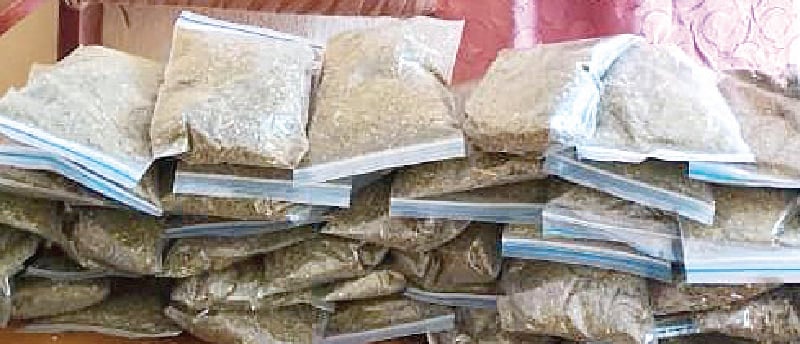
Amidst the hustle and chaos of one of Lagos' most crowded neighborhoods, Isale Oja in Agege, aspirations are slowly being crushed as harmful substances take hold of young people's lives due to long-standing societal neglect. With drug trafficking openly taking place, poverty deeply embedded, and hope quickly disappearing, survival for many young individuals appears increasingly unlikely.IBRAHIM ADAMstates that in this heavily populated area, which is finding it increasingly difficult to manage a worsening crisis, families observe helplessly as their children become more entrenched in a destructive cycle of substance abuse.
InOne of the busy streets in Isale Oja, within the Agege Local Government Area of Lagos State, is where life continues to flourish amid the constant activity of trade. A young man, recognized in his neighborhood as The Law, reportedly passed away following the use of a substance known as Colorado, commonly called Colos.
The Law, still under 30, was one of three brothers struggling with addiction. His older brother, widely referred to as Mission, showed clear evidence of the severe impact of drug abuse, whereas their younger brother, Saddam, continues to be in danger of taking the same dangerous route.
During a visit by Sunday PUNCH To the Capitol Bus Stop, Alagbigba Street, and the twisting lanes of Market Street, it was clear that drug use is a well-known fact.
Young people used drugs and consumed various substances without hesitation, frequently combining harmful chemicals with soft drinks and distributing them freely among friends without facing consequences.
Inquiries showed that The Law and his siblings hail from Kano State, yet the trend of drug abuse goes beyond ethnic lines.
Throughout Agege, families from both Hausa and Yoruba backgrounds experience the sorrow of their children becoming addicted.
Government agencies, including the Lagos State Task Force, often conduct raids during the night, focusing on people believed to be involved in drug use or aggressive actions.
Operations conducted by security forces, as reported byPUNCHOn 21 May and 20 June this year, it was disclosed that 114 individuals suspected of criminal activities were taken into custody in Agege.
The operations targeted areas like the Railway Corridor (Ojurin), Oke Koto, AP, and the Isale Oja neighborhood.
Isale Oja Market, known for its fresh goods such as meat and seafood, continues to be a lively center that draws customers from all over Lagos.
Merchants also offer supplies for age-old customs, turning the market into a key place for everyday requirements and cultural necessities.
The community's vibrant cultural heritage is evident in events such as the annual Gbogunleri Isale-Oja Day, bringing together locals through cultural exhibitions, sports activities, training initiatives, and energetic performances by regional artists.
Even well-known visitors cannot escape the harsh truths of the area.
When Afrobeats artist Adekunle Temitope, widely recognized as Small Doctor, went back to his Agege heritage, he faced a somber situation. In an emotional post onX, he shared:
I walked through neighborhoods on Sunday, and what I witnessed was deeply distressing. The speed at which young men are using drugs these days is concerning.
He vividly portrayed young people who seemed confused, mentioning that some were "asleep while upright," while others adopted strange positions, entirely disconnected from their environment.
Colos as a threat
As reported by the online news site chiexclusive.com, Colos, commonly referred to by street names such as Scooby Snax, Black Mamba, or Potpourri, is a man-made substance created to replicate the effects of tetrahydrocannabinol, the main component in marijuana that causes a "high."
In contrast to natural marijuana obtained from the cannabis plant, Colos is produced by applying synthetic substances to dried plant matter, like cut leaves or grass.
"These substances are designed to attach to the same brain receptors as THC, yet they tend to be significantly stronger and less predictable," the report states. The specific chemical makeup differs from batch to batch and is not controlled, making the drug extremely risky.
Nigerian health influencer and physician Egemba Fidelis, widely recognized as Aproko Doctor, raised concerns regarding Colos' significant mental health and addiction dangers in an Instagram post.
"Similar to other substances, Colorado experiences what is known as tolerance. A single puff today produces a certain effect, but the next day, more is needed to reach the same level of satisfaction. This pattern rapidly results in dependency," he explained.
He explained that Colos is not regular marijuana, but a hazardous combination of cannabis and phencyclidine, a substance previously used as an anesthetic during surgery, yet it was later stopped because of serious adverse effects.
"The primary impact of Colos is hallucination. Your mind starts perceiving things that don't exist. Some experience intense happiness, while others no longer feel pain at all. It is dangerous and users cannot stop taking it whenever they want," warned Aproko Doctor.
"They now suggest, 'Let's try Colorado,' because many of you think you can stop anytime. That's not true. Once you begin, it's a downward spiral. Your body starts to desire it, and when you don't receive it, you might face muscle tightness, seizures, or worse. If you consume too much Colorado, it could result in death, kidney damage, or cause your heart to beat irregularly. So before you participate in the Colos challenge, consider it carefully," he cautioned.
Colos is more dangerous than cocaine
Saddam, the younger sibling of the late The Law, shared with our reporter that Colorado is significantly more dangerous than cocaine and has the potential to ruin a user's life within just a few weeks.
The ex-drug user and supplier stated that Colos has gained more traction among youth in Agege, along with other illegal drugs being sold openly within the area.
He stated, "There are two kinds of Colos. One is known as Colos gbau gbau, which acts instantly. Just one inhalation and you'll experience its effects right away in your mind because it's extremely potent. The other is the regular smoking that induces sleep. I can guarantee that anyone who uses cocaine will be afraid to try Colos. This is a chemical we're discussing."
I am grateful to God that I no longer use Colos, and I can never return to it. Colos? Ha! I have sold all these drugs before, and obtaining them is not hard at all. Just head to Akerele, and you'll find various kinds there. Akerele is the primary drug market here in Agege.
He clearly outlined the severe physical and psychological impacts the drug had on him.
After consuming it, you'd witness me walking and sleeping simultaneously. Occasionally, I would awaken in the morning and begin to roam the neighborhood aimlessly. Upon regaining my awareness, I would plead for money to purchase drugs again on the same day. People in Mushin use drugs, but they don't compare to us in Agege. How many can they consume in a day or a week? With just N150 or N200, you can head to Akerele and obtain anything you desire.
"Drugs don't lead to success; they only cause ruin. Using Colos alone can ruin someone's life. You won't get assistance because of how it alters your body and your life. I know two individuals who passed away in Agege due to Colos. If someone had told me I would quit using it, I wouldn't have believed them. But I have genuinely transformed, and I give thanks to God," he stated.
Saddam also mentioned several of the most frequently used drugs in the region along with their present costs.
As per his statement, Scorches is priced at N2,000 per gram, or N500 for a smaller quantity; Cana is sold at N4,500 per gram, Colos costs N2,000 per gram, or N500 for a small amount; codeine is available for N8,000 per bottle, Chally is N900 for a small portion, and Banku ranges from N15,000 to N18,000 per gram.
He mentioned that SK, ice, crack, and gum are also available and are very affordable.
I took up smoking when I was 11 years old
Saddam expressed profound sorrow, remembering how soon he was exposed to narcotics.
I began using igbo (marijuana) when I was 11 years old. After coming home from school and being instructed to go to work, I refused. Instead, I would return to the same school to smoke with my friends.
You know, teachers usually leave by 4 p.m., and that's when we'll climb the fence into the school grounds to do whatever we please. They've warned me multiple times, but I didn't pay attention, and now I'm dealing with the results.
He admitted that he now experiences true regret and conveyed a wish to abandon the streets of Isale Oja, beginning a fresh life away from its darkness.
I was born and grew up in this neighborhood, and now I'm living like this. Is this a punishment? I've decided to leave so I can be a better individual. My older brother passed away, and I don't wish to meet the same fate. I've made up my mind; I will depart to achieve something significant in life.
I desire the forgiveness of my parents
A different individual facing prolonged addiction described a deeply emotional story of his challenges and remorse.
He spoke to Sunday PUNCHunder the condition of confidentiality, requesting that his name and image not be disclosed to prevent additional embarrassment for his parents.
His eyes filled with tears as he said, "Don't include my name and photo because if you do, it will worsen my parents' issues. They aren't pleased with me, and it won't benefit them. I hope my parents will forgive me since they tried their best to prevent me from doing this."
Currently in his late 30s, he mentioned that his addiction started during his childhood, remembering how everything shifted when he began skipping classes and associating with the wrong people.
"It all began when I was a young child. My parents believed I was heading to school, but once I left the house and reached the Capitol Bus Stop, I would switch my clothes, place them in my bag, and head out to have fun. That's how I met some of my friends," he shared.
He described the time they first enticed him to smoke and drink, slowly drawing him further into a realm of more hazardous drugs, each stage a gradual slide he barely noticed back then.
"They showed me a lot, including how to smoke, drink, and eventually other things. I had no knowledge about women until I saw one of my friends having sexual relations with his girlfriend. I also saw a woman being raped, but I didn't take part. However, you see that drink and Colos, that's something I really enjoy," he said.
He stated that his reliance has gone beyond just a routine, pointing out that what was once a decision has now turned into a necessity, a powerful hold that controls his daily existence.
"I'm not going to lie to you. If I don't take this, I'll die because it's now a part of me. I've been using it for more than 10 years, and you want me to quit? Even my parents did everything they could. When they got tired, they stopped and left me alone," he said with anger.
He described a period when his health worsened significantly, causing others to worry he might not make it.
"There was a period when I was extremely ill; so ill that everyone thought I wouldn't survive. However, I lived. God saved my life. Blame those who anticipated my death," he stated.
The individual acknowledged that he occasionally sees his family, even though they know he is still reliant on Colos.
"Every time I visit my family, they ask me what I need, and I say it's money for food. They know I'm not telling the truth because they know I'll use some of it to buy Colos. Colos is the main meal, my friend. If you take a little bit of it, you'll feel fine," he said, smiling.
He expressed sorrow over how addiction had taken the lives of many of his friends; some had passed away, others were injured, and some had been compelled to leave the neighborhood after being caught stealing to support their drug addiction.
"Some of my friends have moved out of this area. They continued to steal, and when they got caught, they were severely beaten. One almost died before the police arrived that day. I don't steal; I don't take things that aren't mine. However, if I'm referring to you, and I see you after taking my usual meal (Colos), you'll be in trouble," he warned.
For the time being, he lives on the streets, finding places to sleep wherever possible, and acknowledges that going back home is improbable.
"If I returned home, my family would accept me, but I can't because I wouldn't be able to bring Colos with me, and they wouldn't grant me the freedom I require. I sleep anywhere. Where do I find the money to rent a place?" he questioned.
Colos gradually endangering our kids – Resident
A member of the neighborhood, who had a conversation withSunday PUNCHunder circumstances of anonymity to prevent facing retaliation, brought attention to the harsh truth of drug addiction within households and its severe impact on communities.
The Law was less than 30 years old when he passed away. Unfortunately, he is not the only one. Within their family, three members are involved in drug use. What astonishes me the most is that these boys are not Yoruba but rather Hausa. There is also another Hausa family, consisting of Jafar, Imam, and Colo, who are engaged in drug use. In this area, both Hausa and Yoruba families are impacted.
"We hope the death of The Law will make them reconsider and stop using these substances. The drug they use, known as Colos, is extremely hazardous. Anyone who uses Colos becomes thin and weak, appearing almost like characters from horror films. Even individuals who use gbana (cocaine) are scared of Colos due to its adverse effects. I don't understand why anyone would still opt for it. It's pure poison. For just N500, anyone can purchase it," he said.
The inhabitant pointed out the tragic number of deaths in the area, stating, “Since I have been living here, I have witnessed at least five young boys pass away due to Colos. They believe they are having fun, but actually, they are gradually harming themselves.”
Slow death
A former drug user, widely recognized as Bature, who spent over ten years using marijuana, spoke openly about his difficult experiences, recounting his story as a warning for younger generations.
"Ten long years of my life. And what did I achieve? Nothing. Even with a stable job, I spent all my money on medical care. People started viewing me as careless. But now that I've stopped, look at me, I'm in good health, full of confidence, and doing well again," he said.
Bature emphasized that what many young people view as enjoyment is, in fact, self-destruction.
"I wish to inform these young boys that what they refer to as fun is truly a slow form of death. They must cease this before it completely ruins them. I am also urging community leaders and those involved to unite and take action. These youths have tarnished the reputation of our community, and if no steps are taken, even our young children will come to see this behavior as normal. It's time to act now," he cautioned.
A pharmacist’s ruined life
A prominent pharmacist in the neighborhood, Allison, expressed sorrow while discussing the personal and professional damage resulting from selling codeine syrup.
"This pharmacy wasn't like this previously. It was once completely well-stocked; all the items you required were available here. However, everything altered when I began selling drugs, particularly codeine. That's when problems started," he mentioned.
He described the numerous arrests and the subsequent public embarrassment, explaining how every occurrence gradually damaged his reputation and income.
"The NDLEA agents have arrested me so many times that they are exhausted. They come here, humiliate me in front of everyone, take me away, and then let me go. They have taken everything I worked for. My empty shop tells the whole story. I have nothing left," he stated.
A local resident, Tajudeen Alli, stated that Allison has ceased purchasing and using codeine.
"I can confirm that he no longer sells codeine. I don't believe he will ever attempt it again," he stated.
Describing a harrowing operation conducted by NDLEA agents, he stated, "I recall when the officers arrived to take him into custody. They treated him harshly, like a child, and pulled him away. After he was released on the same day, his wife and children implored him to cease selling codeine. For the time being, he has stopped, which is why we are able to be with him now. Back then, no one dared to be here because if the agents showed up, they would arrest everyone."
Affluent clients drive the sale of narcotics
A different drug dealer, who has a disability, shared with Sunday PUNCH that the demand from affluent customers and economic hardship sustain the drug trade.
Drug trafficking cannot be stopped. Who is going to stop it? You? Let me share something with you, you see all these nicely dressed individuals driving around in cars, they purchase from us. I sell Colos, ice, and gum for as low as N500. If you need it, I am here for you.
"There is no job. How do you expect me to avoid selling drugs? How will I support my family? The government doesn't view us as people. This is the only way to stay alive. Visit Akerele, where young boys are dealing drugs," he said.
Costly visit to Akerele
Following a conversation with the drug dealer, our reporter went to investigate the accuracy of his statements, entering Akerele pretending to be a customer.
As he moved around, slipping through the backstreets, one of the vendors nonchalantly gestured for him to come along, taking him through a labyrinth of stalls and shadowy areas where transactions were made in hushed tones.
He fit in, negotiating as told and secretly capturing images. However, the mood changed the instant a new set of traders arrived.
Some of the people there were from his history; old friends who recognized him not as a client, but as a reporter. In a moment, the mood turned tense.
They approached closely. His phone was taken from him, and they searched through it with skilled intensity, deleting photos and recordings one by one. Their gazes became colder as they interrogated him, and the atmosphere turned threatening.
Next came the ultimatum: purchase drugs and pay a heavy price, or face the repercussions. Trapped and outmatched, he had no choice but to hand over more than N50,000 before they consented to let him go.
A vendor, full of resistance, issued a terrifying message: "If the government and police can't stop us, who is a journalist? They didn't offer us work, and you're here to report on us. Be grateful; we could have killed you, and no one would have found your body."
Overpopulation and inadequate family planning exacerbate societal issues.
A local resident, Ajose Ibrahim, linked the increase in drug use and violence in Agege to overpopulation, lack of education, and inadequate family planning. He characterized the neighborhood as distinctly varied but extremely congested.
"Agege is inhabited by individuals from various backgrounds; you can encounter Yorubas, Hausas, Togolese, Ghanaians, Senegalese, and Malians here. It's almost like a small Economic Community of West African States. However, in Isale Oja, the Hausas form the biggest group," he mentioned.
Ajose stated that factors such as overpopulation, poverty, religious beliefs, and lack of knowledge among certain residents have resulted in families having more children than they are able to support.
"You will witness an unemployed individual battling to provide for himself and his family, yet he has 10 to 15 children. Some people earning under N50,000 monthly have as many as 16 children. How can someone in this situation adequately care for their children?" he questioned.
Ajose also criticized certain working women who, although they earn money, give their income to their husbands rather than focusing on their children's well-being.
"It is even more disappointing that some working women hand over their small earnings to their husbands rather than using the funds to adequately care for their children," he added.
Ajose urged the appropriate agencies, such as the NDLEA and the police, to implement more robust actions.
"The NDLEA, the Police Area Commander, and the Divisional Police Officer must take further action. However, as long as individuals use religion as a cover to have more children than they can support, drug abuse and violence will continue to be challenging to eliminate," he stated.
Stakeholders children involvement
Inhabitants of Isale Oja claim that minors from well-known and powerful families are responsible for a significant portion of the unlawful behavior in the region.
A female inhabitant, who requested to remain unnamed, stated that the neighborhood has turned dangerous because of the participation of these well-connected young people in drug use and unlawful acts.
"One of the key issues we face here is that children from famous families are involved," she stated.
She stated that the majority of conflicts, thefts, and disruptions are planned by these young individuals, who head opposing groups and frequently escape punishment due to their parents' power.
"When you hear about crime or conflicts occurring in various places, it's often their children who are involved. They serve as the main organizers, leading different groups. How can crime be prevented if children are arrested and their parents do everything possible to get them out?" she added.
The inhabitant remembered multiple occasions when police conducted raids on Isale Oja and found weapons that surprised the community.
"We have witnessed police operations revealing firearms that we typically only see on TV or carried by law enforcement. How do they manage to obtain these weapons? If they are arrested today, they will likely be released after a few days. Occasionally, when the police fail to catch them, they just move out of the area for a while and come back once the situation has died down," she stated.
Substance misuse exacerbates the mental health emergency
A psychiatric consultant at the University of Ilorin Teaching Hospital, Dr. Adebusola Ogunmodede, during an interview withSunday PUNCH, cautioned that substance misuse can have severe adverse impacts on the minds of those affected, leading to an increase in mental health issues within societies.
"Drug misuse can have significant effects on the mind, such as raising the likelihood of experiencing depression, anxiety, and psychotic conditions," she stated.
She stated that new research suggests that regular marijuana use may increase the risk of experiencing anxiety and depression-related conditions.
"For example, research has shown that regular or frequent cannabis consumption over time may raise an individual's likelihood of experiencing anxiety- and depression-related conditions. We also understand that depression is the most prevalent mental health issue linked to suicide worldwide," she stated.
Ogunmodede pointed out that various substances, such as cocaine, heroin, and methamphetamine, are associated with psychosis.
She emphasized that addiction is now regarded as a brain disorder, noting that although it does not directly raise the risk of mental health conditions, it is linked to emotional issues.
"The effect on the community is a growing number of people suffering from mental health issues and behavioral problems. This influences daily living, puts pressure on personal connections, and interferes with societal harmony," she further stated.
A municipality's ongoing battle against drug addiction
The head of Agege Local Government, Ganiyu Obasa, spoke about the growing issue of drug consumption in the region, expressing his dedication to combating drug addiction and crime.
"We have met with individuals involved in peace and security, and we continuously encourage our people: if you notice anything, speak up. Do not conceal any information. Peace and security are strongly connected to drug abuse, which is common in our neighborhood. It ruins lives and communities," he stated.New Telegraph in an interview.
Obasa mentioned that the council has contacted the NDLEA regional office in Ikoyi for assistance.
"They have carried out raids and awareness campaigns in the communities. We are also working with the police to discover long-term solutions to the issue," he stated.
Authorities unreachable
Despite numerous calls and texts,Sunday PUNCHWas unable to contact the Lagos Police Public Relations Officer, SP Abimbola Adebisi, and the NDLEA Lagos State Commander, Abubakar Wali, to discuss the issue of drugs in this Lagos neighborhood and the measures being taken to address it.
Provided by SyndiGate Media Inc. (Syndigate.info).