
The costs of some supermarketPrivate-label products are gaining popularity, with eggs, butter, and cheese contributing to higher prices.
More consumers are turning to budget-friendly options for their everyday kitchen essentials in an effort to save money.
However, if they believe their money is not stretching as far, they are correct.
The price of the most affordable store-brand canned tomatoes has increased by 10 percent compared to last year in certain large supermarkets, while butter has risen by 11 percent, according to an analysis byThe i Paper has found.
Several of the most commonly purchased foods, both branded and generic, have also seen increases. The average price of milk has gone up 2.3 per cent, coffee by 4.3 per cent, and chicken breast by 5.5 per cent since October 2024.
Products that have experienced the largest percentage rise include carrots, which have increased by an average of 107.9 percent. Growers of this modest vegetable have faced reduced output due to floods and dry spells.
According to Which?, consumers are increasingly opting for budget and store-brand items when facing financial constraints.
The consumer group discovered that premium in-house food and beverage items experienced the greatest inflation rate when compared to other product lines, with their prices increasing by 8.6 percent annually in August.
The i PaperThe analysis examined everyday items available on the supermarket comparison site Trolley.co.uk between October 2024 and October 2025, evaluating similar products across Sainsbury’s, Tesco, Asda, Morrisons, and Aldi.
Some positive news for shoppers – not every store-brand essential has increased in cost. In fact, certain items, like olive oil, have become cheaper.
In addition, the consumer insights company Worldpanel, part of Numerator, reported that the prices of coffee, fresh meat, and chocolate increased the most during the previous month, whereas the costs of kitchen roll, toilet paper, sugary snacks, and dog food decreased the most.
The changing cost of products is impacting consumers such as pensioner Margaret Hassan. "I purchase less [coffee]," she mentioned during her weekly shopping trip in Barkingside, Essex. "I have begun consuming more green tea."
Many of the items she purchases are from store-owned brands. Hassan believes she is receiving good value for her money even with some increases in prices, "especially at Sainsbury’s because of Nectar. You accumulate a lot of Nectar points."
But for the top deals,Which?suggests that shoppers should go beyond conventional supermarkets and opt for Home Bargains or B&M, which it claims are more affordable on average.
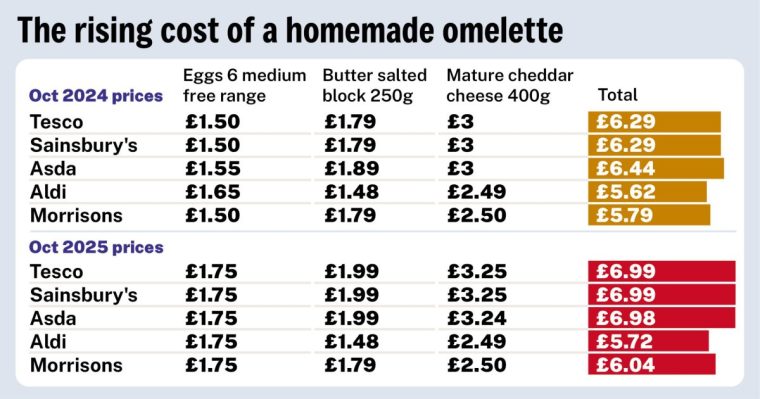
The expense of preparing an omelette has increased
A branded box containing six medium-sized free-range eggs was available for £1.50 last year at Tesco, Sainsbury’s, and Morrisons – they now retail for £1.75, as reported by Trolley.co.uk.
This year, the cost has increased at Asda and Aldi, rising from £1.55 and £1.65 respectively to £1.75.
Packs of branded salted butter (250g) increased from £1.79 to £1.99 at Tesco and Sainsbury’s, and from £1.89 to £1.99 at Asda. However, the cost remained unchanged at Morrisons and Aldi (£1.79 and £1.48 respectively).
The rise in prices for eggs and butter is mainly due to increased demand, reduced supply, and higher labor expenses, as reported by the British Retail Consortium (BRC).
Mature cheddar cheese has experienced a price hike in various supermarkets, with a 400g block going up from £3 to £3.25 at Tesco and Sainsbury’s and to £3.24 at Asda.
This indicates that the typical cost of the components needed to prepare a basic cheese omelette from scratch has increased by up to 11 percent within a year.
The cost of food has increased partially due to retailers managing their own expenses, as stated by the BRC.
"Retailers are facing an extra £5bn in expenses due to the rise in Employer National Insurance contributions and the National Living Wage starting in April," noted its economist Havir Dhillon.
"The outcome is that food inflation has been increasing in recent months," he stated, noting that retailers are making every effort to maintain low prices.
The government should guarantee that retailers are not subjected to additional costs caused by policies, supporting their initiatives to control inflation on necessary goods.
Other elements, including bad harvests and severe weather, have also made a difference.
The foods that are more affordable nowadays
The cost of olive oil has increased in recent years because of drought and unusually high temperatures across Europe. However, the price of a 1-liter bottle of extra virgin oil has decreased by as much as 20 percent at Sainsbury’s, Tesco, Asda, and Morrisons when looking at data from October 2024 to October 2025. It is still priced at £3.69 at Aldi.
Own-brand spaghetti packets (500g) have dropped by 10p to 65p at Tesco and 75p at Sainsbury’s. The average price remained unchanged at 75p in the year leading up to October 2025 at other supermarkets.
Although beef mince has become pricier at certain grocery stores, the expense of preparing a basic spaghetti bolognese has dropped by up to 16 percent.
Although the average cost of carrots has increased by over 100 percent, supermarkets offer their own brand alternatives that have remained unchanged in price.
"The cost of private label products, regardless of their premium status, can differ significantly across different supermarkets," said Fraser McKevitt, head of retail and consumer insight at Worldpanel.
He anticipates a rise in promotions as we move into December, alongside high-end private-label sales, which are projected to exceed £1 billion for the first time.
Customers are "more inclined to visit various supermarkets to find a lower cost for a well-known product, but when it comes to a store-brand item, they tend to remain loyal even if the price goes up," McKevitt mentioned.
He mentioned that individuals frequently seek outstanding value and quality, rather than simply the most inexpensive item.
This emotion was shared by grocery store customersThe i Papercontacted in Barkingside. Najla Ahmad's trolley at the Tesco superstore was filled with a combination of branded and store-owned items. The teaching assistant and mother of three mentioned that she looks for discounts on certain products, such as coffee.
"When I come across the deal, I purchase two or three packages to make it last," she stated.
Which?Retail and finance correspondent Reena Sewraz stated, "There are still ways individuals can cut costs on their grocery shopping. Trying a more affordable supermarket is the most effective step. According to our monthly study, there's a 35 percent variation in price for the same set of groceries between the cheapest and priciest supermarkets."
It's also beneficial to consider options outside of conventional supermarkets. We recently discovered that Home Bargains and B&M offered lower prices on average compared to major supermarkets for more than 200 items, such as branded canned and packaged foods.
When funds are limited, consumers might opt for cheaper and store-brand items – our taste evaluations have shown these frequently outperform name brands in terms of taste and cost-effectiveness.
Saeed Ibrahim from Trolley.co.uk mentioned that the changing cost of groceries has made "the advantage of shopping at one store is now lost."
He mentioned that the number of individuals using the price comparison website to check prices and shop around has increased by 23-25 percent each month when compared to the same period last year.
Asda stated that it is investing "substantially to reduce prices and protect our customers from inflation."
From the beginning of the year, over half of our products have seen price cuts, with many more reductions expected as we approach the holiday season.