
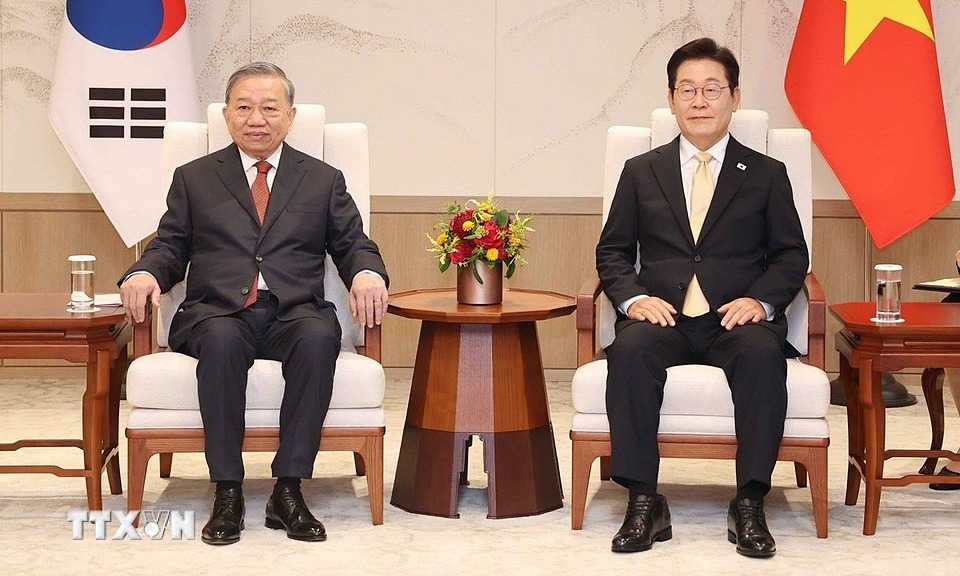
Strengthening Bilateral Ties: Vietnam and South Korea Deepen Strategic Partnership
Vietnam and South Korea have taken significant steps to enhance their bilateral Comprehensive Strategic Partnership during a state visit by Vietnamese Party General Secretary To Lam and his spouse from August 10 to 13. The visit culminated in a joint statement that outlines the direction of cooperation between the two nations, emphasizing mutual respect, shared goals, and long-term collaboration.
The joint statement highlights the remarkable progress in bilateral relations since the establishment of diplomatic ties in 1992, especially following the elevation of the relationship to a Comprehensive Strategic Partnership in 2022. Both leaders acknowledged the importance of this partnership, recognizing each other as leading and important partners across all fields.
Expanding Cooperation Across Multiple Sectors
The two countries agreed to deepen cooperation in various areas, ensuring tangible benefits for their citizens and contributing to regional and global peace and stability. They emphasized the need for high-level exchanges through bilateral visits, international forums, multilateral conferences, virtual talks, and written correspondence. The agreement includes strengthening cooperation through Party, Government, National Assembly, ministerial, and locality-to-locality channels, as well as among citizens from different walks of life.
They also stressed the importance of updating each other on the implementation of cooperation documents signed between high-ranking leaders, including the Action Programme to realize the Vietnam-South Korea Comprehensive Strategic Partnership.
Defense and Security Collaboration
In the defense and security domain, the two countries committed to expanding ministerial talks, strategic defense and security dialogues, and police conferences. They pledged to increase delegation exchanges and expand cooperation in maritime security and training, with the resumption of the Joint Committee on defense industry and logistics. Additionally, they aim to collaborate on defense technology, industry, and security through concrete projects, while enhancing links between defense enterprises.
Both nations also pledged to bolster collaboration on demining operations, United Nations peacekeeping, information sharing on strategic issues, tackling non-traditional security threats, and transnational crime. They also agreed to coordinate more closely on consular and judicial matters, including cases involving detained nationals.
Economic Development and Trade
Economically, the two countries reaffirmed their goal of raising two-way trade to $150 billion by 2030 in a balanced and sustainable manner. They will promote long-term, strategic cooperation in trade, investment, industry, energy, and technology, as well as supply chains. Mechanisms such as the Vietnam–South Korea Deputy Prime Minister-level Economic Dialogue, the Inter-Governmental Committee, and the Joint Committee for implementing the Vietnam–Korea Free Trade Agreement (VKFTA) will be expanded.
Both sides also pledged to work closely within regional and multilateral economic frameworks, including the ASEAN–Korea Free Trade Agreement (AKFTA), the Regional Comprehensive Economic Partnership (RCEP), and the Indo-Pacific Economic Framework for Prosperity (IPEF).
Encouraging Investment and Infrastructure Projects
South Korean officials requested Vietnam’s support for Korean companies to engage in infrastructure projects, while Vietnam reiterated its commitment to an open, transparent, and stable investment environment for foreign enterprises, including those from South Korea. Vietnam expressed interest in having capable Korean firms join its strategic infrastructure projects in nuclear power, renewable energy, electricity grids, and high-speed rail.
The two sides commended the positive outcomes achieved through cooperation between their financial and monetary authorities, agreeing to develop a shared database system for Vietnam’s insurance sector to establish a transparent and sustainable insurance market. They also discussed setting up relevant cooperation mechanisms to implement knowledge-sharing projects in the financial sector.
Science, Technology, and Innovation
Science, technology, innovation, and digital transformation were identified as priority areas, with plans for joint research, training, and exchanges in AI, semiconductors, biotechnology, materials, and energy. They also agreed to expand cooperation in renewable energy, improve energy efficiency, and strengthen information exchange in oil and gas exploration and extraction.
Development Cooperation and Sustainable Initiatives
Both sides affirmed their determination to continue implementing bilateral cooperation in development based on agreements such as the Framework Agreement on the Economic Development Cooperation Fund (EDCF) and the Economic Development Partnership Fund (EDPF) Cooperation Agreement, each worth $2 billion until 2030. Vietnam appreciated South Korea's efforts in implementing official development assistance projects and requested continued support for large-scale projects such as energy transition, environment, healthcare, green infrastructure, and transportation.
Labor, Healthcare, and Education Cooperation
Labor, healthcare, and education cooperation were highlighted as key areas. Both sides agreed to exchange policies and sign a Memoranda of Understanding in public personnel management. They also discussed simplifying work permits for Korean citizens and expanding industries accepting Vietnamese workers.
Healthcare cooperation will focus on technology transfer, biotechnology research, genetic technology, AI applications, and telemedicine. Education initiatives include increased scholarships for Vietnamese students, particularly in AI and STEM fields, digital transformation programs, and the compilation of Korean language textbooks for Vietnam's curriculum.
Sustainable Development and Climate Change
The two sides agreed to fully implement bilateral cooperation on climate change, exchanging policies and technologies for greenhouse gas emission reduction and climate change adaptation. They also emphasized collaboration in the Reduced emissions from deforestation and forest degradation (REDD+) project, forest preservation, water resources management, and environmental protection initiatives.
Agricultural cooperation emphasizes high-tech and smart farming to reduce emissions, with technology sharing across production, processing, and distribution of food products where both countries have advantages.
Cultural, Sports, and Tourism Exchanges
Cultural, sports, and tourism exchanges were also prioritized. Both sides agreed to boost cooperation in exchanges and activities promoting culture, sports, and tourism, and to organize cultural events such as exhibitions, performances, cultural days, and cultural weeks in each other’s territories.
International and Regional Collaboration
Both sides reaffirmed their commitment to enhancing cooperation within ASEAN and Mekong sub-regional mechanisms, such as ASEAN–RoK, Mekong–RoK, ASEAN+3, the East Asia Summit (EAS), the ASEAN Regional Forum (ARF), and the ASEAN Defense Ministers’ Meeting Plus (ADMM+). They also emphasized the importance of resuming the Mekong–RoK Summit at an appropriate time to realize the vision of building a people-centered community for peace and prosperity in the region.
Commitment to Peace and Stability
Both sides reaffirmed the importance of ensuring peace, stability, respect for international law, and freedom of navigation and overflight in the East Sea. They also emphasized the need for the full and effective implementation of the Declaration on the Conduct of Parties in the East Sea (DOC) and for the early finalization of a substantive and effective Code of Conduct in the East Sea (COC) in accordance with international law.
Vietnam welcomed and supported the Korean Government’s efforts to resume inter-Korean dialogue and cooperation, expressing readiness to contribute to creating an environment of peace, stability, and prosperity on the Korean Peninsula.
The state visit by Vietnamese Party General Secretary To Lam and his spouse was hailed as a great success, marking a significant milestone and opening a new chapter in the Vietnam–South Korea Comprehensive Strategic Partnership.