
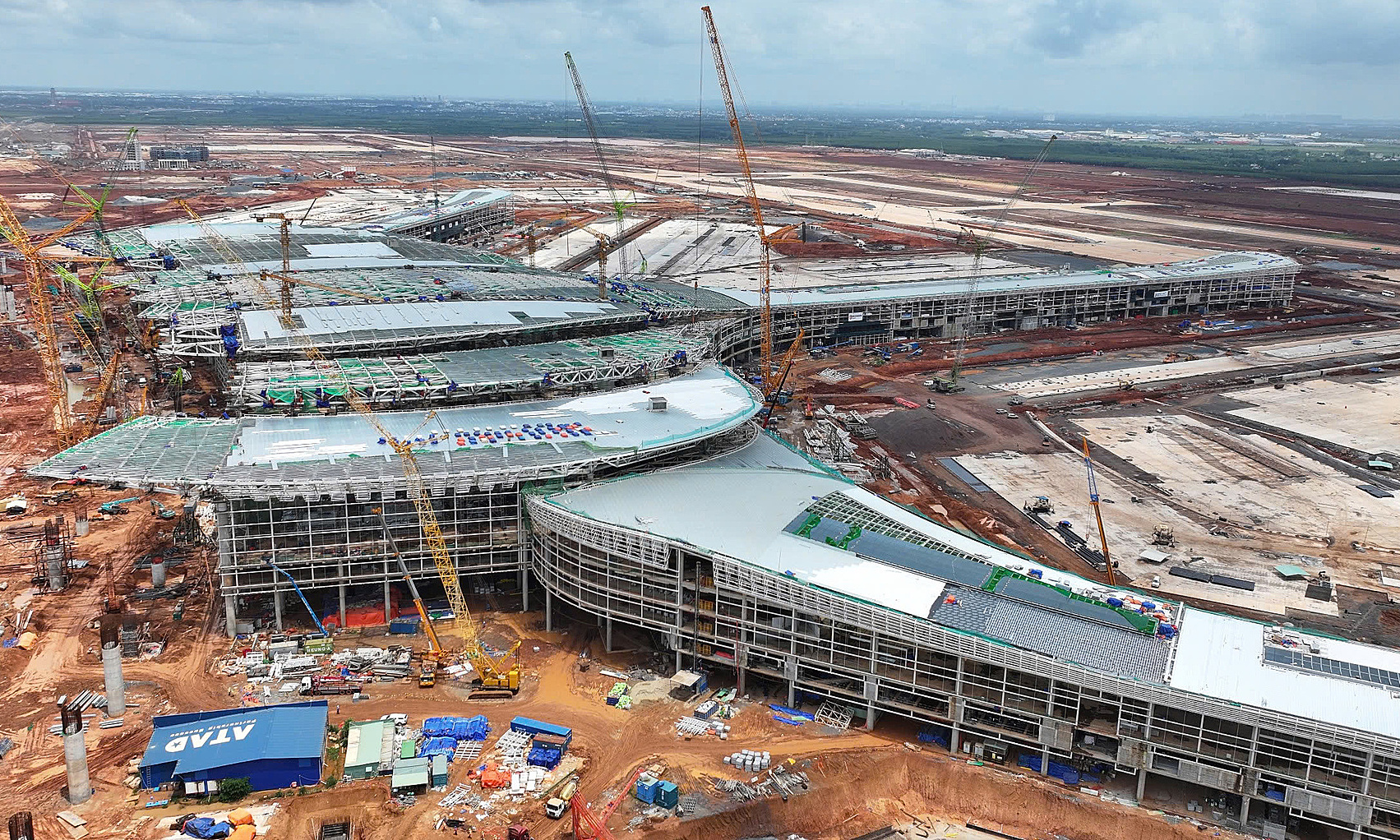
Challenges in Accessing Long Thanh International Airport
The opening of Long Thanh International Airport, scheduled for next year, faces significant challenges due to existing traffic congestion and incomplete infrastructure. Experts warn that the current routes connecting the airport to Ho Chi Minh City are already heavily burdened, and without urgent improvements, the situation is expected to worsen.
Tran Ngoc Thanh, a 45-year-old driver who frequently transports passengers between Dong Nai and HCMC, describes the daily struggle of navigating National Highway 51 and the HCMC–Long Thanh–Dau Giay Expressway. Despite the 60 km trip with a speed limit of 120 kph, he often spends two to three hours on the road, especially during repairs or accidents. This route has become increasingly congested over the years, with hotspots like the National Highway 51 interchange, Long Thanh Bridge, and An Phu often jammed even during off-peak hours.
For nearly a decade, Tran transported goods from HCMC's wholesale markets to Long Thanh before switching to a passenger car. He notes that the only expressway linking Dong Nai and HCMC has become more crowded, making it difficult to find alternative routes. While taking National Highway 51 and the Dong Nai Bridge is longer, it is also frequently clogged, leaving drivers with few options.
Recent repairs on expansion joints near Long Thanh Bridge caused severe congestion, with some drivers spending eight to 10 hours covering just 100 kilometers between HCMC and Vung Tau via Long Thanh. As the airport prepares to open, concerns about increased traffic are growing, especially if the expressway is not widened or additional access routes are not developed.
Many other drivers transporting passengers from Long Thanh to Tan Son Nhat Airport face similar difficulties. Some opt for National Highway 51, National Highway 1K, and Pham Van Dong Boulevard, but these alternatives are not much better.
The Vision for Long Thanh International Airport
Built on 5,000 hectares at a cost of VND336 trillion (US$12.8 billion), Long Thanh will be Vietnam’s largest airport. Phase one aims for completion by the end of this year, with inauguration in 2026. It will have a capacity of 25 million passengers and 1.2 million tons of cargo annually.
Beyond meeting travel demand, the airport is envisioned as a "growth pole" for the southern key economic region, with HCMC as its hub. However, current access to the airport relies on two main routes—the Long Thanh–Dau Giay Expressway and National Highway 51—both of which are overloaded.
Other arterial routes, such as the Ben Luc–Long Thanh Expressway and HCMC's Ring Road 3, are under construction, while others like the Thu Thiem–Long Thanh railroad and a metro link with Tan Son Nhat airport are in planning or pre-feasibility study stages.
Architect Ngo Viet Nam Son warns that without synchronized infrastructure development, traffic pressure will continue to increase once the airport opens. He emphasizes the need to accelerate projects like the Ben Luc–Long Thanh Expressway and Ring Road 3, and to widen the Long Thanh–Dau Giay Expressway.
Urban economist Dinh The Hien agrees, noting that Long Thanh is expected to reach peak efficiency around 2027 or 2028. This timeline aligns with the completion of key projects like the widening of the Long Thanh–Dau Giay Expressway and the completion of Ring Road 3, Ben Luc–Long Thanh, and Bien Hoa–Vung Tau highways.
To support domestic and international transfer passengers in the initial phase, smartly organized bus routes are essential for convenience and efficiency.
Infrastructure Development and Future Plans
According to the Vietnam Expressway Corporation (VEC), the widening of the HCMC-Long Thanh–Dau Giay Expressway will start on August 19. A 22-km upgrade targets basic completion in 2026, widening the carriageway from four to 8–10 lanes. HCMC will also widen over three kilometers of approach roads to the An Phu interchange to relieve a key bottleneck for airport access.
VEC has opened nearly 30 km of the Ben Luc–Long Thanh Expressway and expects its completion in 2026, creating a major artery to the airport. At a workshop held in June, Tran Quang Phu, vice rector of the HCMC University of Transport, emphasized the need for a multimodal network comprising metro, BRT, high-speed rail, waterways, and smart operations.
Railroad plans include the Thu Thiem–Long Thanh line and the North–South high-speed rail. The Thu Thiem–Long Thanh line, over 48 km long, is estimated to cost $3.5 billion. The Ministry of Construction is finalizing a pre-feasibility report for submission to the National Assembly for approval in October 2025.
If approved, construction will begin between late 2026 and 2029, with commercial operations starting in 2030. The HCMC government will oversee the work.
Prime Minister Pham Minh Chinh recently emphasized the need to complete Long Thanh International Airport by December 19, 2025, and begin commercial operations in early 2026. He praised efforts to accelerate progress but warned that remaining tasks are complex and time is running out. He called for tighter coordination, mobilization of additional resources, and full engagement of contractors, subcontractors, and authorities to speed up work wherever possible.
He also urged studies to develop an airport city, aviation industrial park, free trade zone, and logistics hub around the airport.