
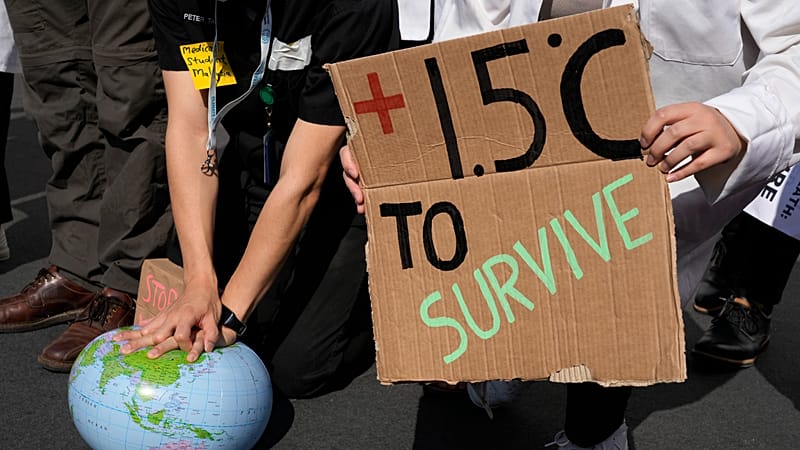
Climate leaders around the globe are acknowledging that Earth's temperature rise will exceed a critical threshold established ten years ago, aiming to prevent the planet from entering a hazardous area. However, they are not giving up.
Officials from the United Nations, along with scientists and experts, are placing their expectations on ultimately bringing global temperatures back under the critical threshold established in the 2015 Paris Agreement, which aimed to keep warming below 1.5°C compared to pre-industrial levels.
Breaking through that limit and then returning is referred to as "overshoot." In the context of climate science, it doesn't imply crossing a threshold and never returning — rather, it involves recognizing the threshold in the rearview mirror and making a U-turn to return to cooler temperatures.
Following years of regarding the 1.5°C threshold as an absolute limit that must not be crossed, authorities have, in recent weeks, begun discussing ways to restrict how long and how much the planet remains in the hazardous range.
The 1.5°C target is derived from temperature averages spanning a ten-year period.
It's not a target, it's not an objective, it's a boundary
Numerous scientists believe that crossing the 1.5°C threshold is unavoidable. The threshold will only be officially recognized as exceeded once the Earth's temperature surpasses it for a 10-year average. Currently, the temperature is approximately 1.3°C, and last year alone surpassed the 1.5°C level.
It could be unavoidable, yet it won't be pleasant, they claim.
"Breaching the 1.5°C threshold poses a genuine risk of initiating irreversible changes in Earth's systems," stated Johan Rockstrom, director of the Potsdam Institute for Climate Research in Germany and a scientific advisor to the UN's annual climate conference, which is currently taking place in Belem, a city in the Brazilian Amazon.
Those dangers involve the worldwide extinction of coral reefs and a rapid increase in deadly heatwaves. There is also a possibility of initiatingtipping pointsRegarding irreversible changes, such as the drying up of the Amazon rainforest, the melting of ice sheets in Greenland and Antarctica, and potentially the collapse of the entire Atlantic ocean current system, stated Rockstrom and Bill Hare, CEO of Climate Analytics.
Similar worries were highlighted in a 2018 UN special report that demonstrated how 1.5°C marks the beginning of the critical zone.
"In Belem, we now possess more scientific evidence than we did 10 years ago indicating that 1.5°C is a genuine threshold. It isn't a target, nor a goal, but rather a limit, a boundary," Rockstrom stated to The Associated Press.
Move past it, as we intensify the suffering of individuals, and we heighten the likelihood of surpassing critical thresholds.
Possibly a violation
Over the past few years, researchers have indicated that although it is theoretically feasible for global temperatures to remain at or below 1.5°C, it is not practical.
They estimate the planet is on track for 2.6°C ofwarmingSince the middle of the 1800s, marking the beginning of the Industrial Revolution and a significant increase in the use of fossil fuels such as coal, oil, and gas.
For many years, UN representatives have maintained that the 1.5°C target remains achievable. However, despite their continued assertion that the goal is still relevant, these same leaders have recently admitted that it is likely to be exceeded in the near future or within the next few decades.
"The science is clear: It is possible and necessary to reduce temperatures back to 1.5°C following any short-term exceedance," said UN climate chief Simon Stiell as this year's conference commenced.
UN Secretary-General Antonio Guterres, addressing an audience in Geneva last month, was more direct, although he also expressed optimism.
Gutteres stated, 'Overshooting is now unavoidable, meaning that we will experience a period, whether longer or shorter, with greater or lesser intensity, above 1.5°C in the coming years.' 'This does not imply that we are destined to live with a 1.5°C loss. No.'
UN representatives stated that the objective of limiting global warming to 1.5°C should continue to be pursued even if the planet surpasses this threshold, as it remains a significant and valuable aim.
Excess is a default stance
The concept of overshoot refers to temperatures exceeding the 1.5°C threshold, but eventually decreasing in the future.
The aspiration is that when the world ceases to imposegases that trap heat in the atmosphere Emissions from burning coal, oil, and natural gas can be reduced by natural carbon sinks like trees and oceans, which absorb carbon pollution from the atmosphere. There is also optimism that emerging technologies may extract carbon dioxide from the air.
When the level of carbon in the atmosphere decreases, temperatures will also drop—eventually. Much relies on technology that has not yet been developed on a sufficient scale to make a difference.
"Without the removal of carbon dioxide, it is entirely impossible to handle the overshoot scenario," stated Ottmar Edenhofer, chief economist at the Potsdam Institute for Climate Research and chair of the European Scientific Advisory Board on Climate Change.
Researchers are uncertain about the precise timing and location where the risk becomes critical during an overshoot scenario, and it remains unclear whether prolonged exposure above 1.5°C warming is more hazardous, or if reaching significantly higher temperature levels than 1.5°C poses a greater threat.
But they are aware that the world is expected to remain in that area for many decades.
Recent research from scientists affiliated with the Climate Action Tracker indicates that if global efforts to cut emissions reach their maximum potential — an achievement that has never occurred before — temperatures are expected to exceed 1.5°C by approximately 2030. The report suggests that the peak could reach 1.7°C and it would not drop below that level until the 2060s.
However, the current trajectory of the world is not just a minor deviation, but rather a complete failure, with temperatures continuing to increase by 2100, Hare stated.
"Ten years back, we had a more structured approach to avoiding 1.5°C completely, essentially with minimal or no exceedance," Rockstrom stated.
Now, ten years later, we have failed.