
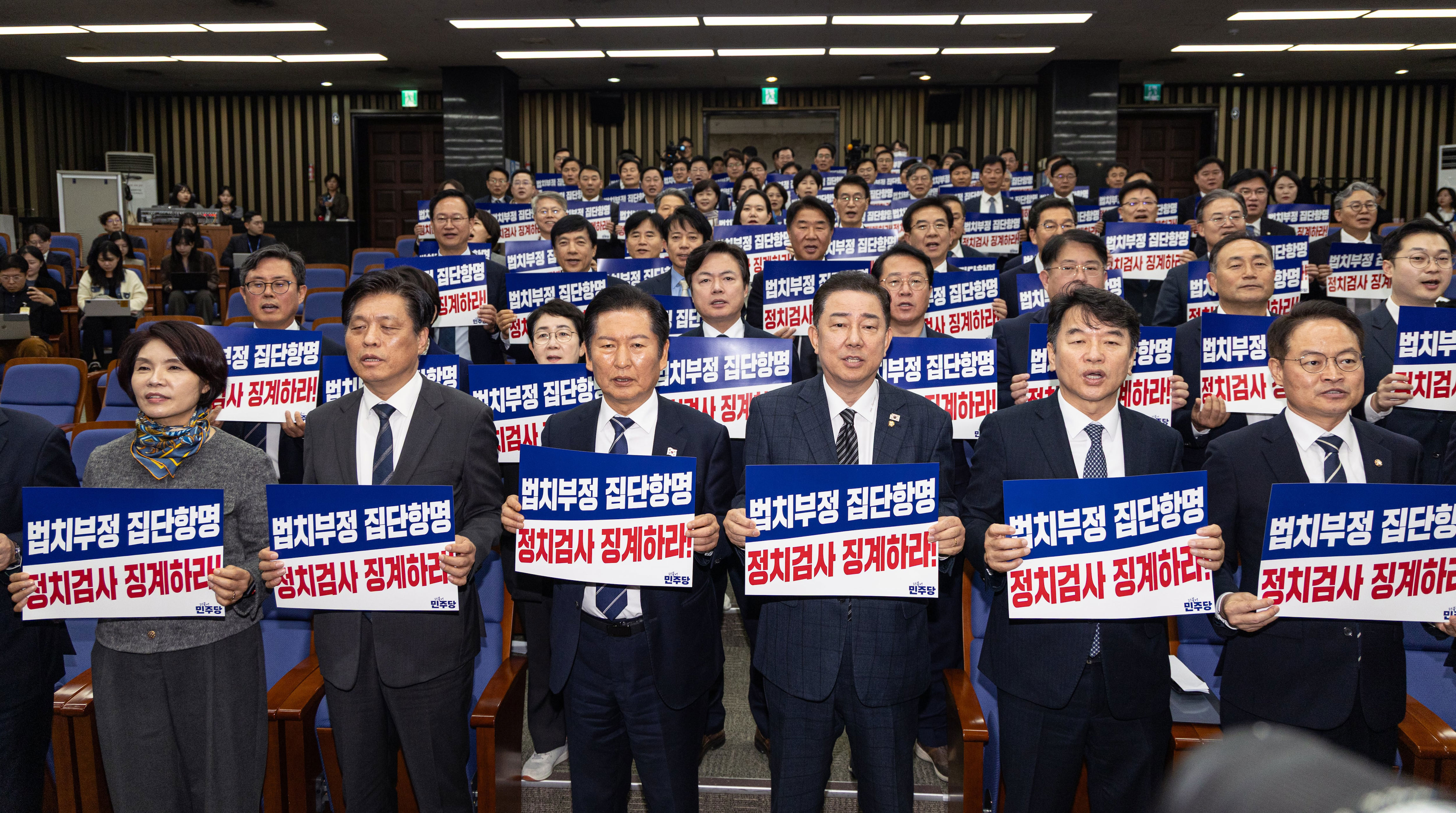
The Democratic Party of Korea stated on the 14th about prosecutors who opposed the choice to stop the appeal in the Daejang-dong case, "Prosecutors who disobeyed orders should be immediately examined and removed from their positions." This came as a reaction to prosecutors' request for Acting Prosecutor General Noh Man-seok to "clarify" the reasons and legal basis for discontinuing the appeal, which the party labeled as "non-compliance." On the same day, the Democratic Party also introduced the so-called "Prosecutor Dismissal Act," enabling prosecutors to be removed without needing impeachment processes similar to other public officials, and announced intentions to enact it within the year.
On the same day, the Democratic Party said, "We call on Justice Minister Jung Sung-ho to promptly start an investigation into the chief prosecutors who opposed the choice to drop the appeal and implement actions like disciplinary measures, termination, and transfer." Previously, 18 senior prosecutors issued a statement on the prosecution's internal network on the 10th, asking Acting Prosecutor General Noh Man-seok to "clarify the reasons and legal basis for discontinuing the appeal."
The legislation introduced by the Democratic Party, known as the Prosecutor Dismissal Act, requires prosecutors to adhere to disciplinary actions, such as suspension or termination, in line with the State Public Officials Act. It also enables the removal of the chief prosecutor without needing an impeachment ruling from the Constitutional Court. Regarding the appointment of chief prosecutors, administrative actions can be implemented to transfer them to regular prosecutor positions rather than their current high-ranking posts.
The People Power Party criticized, "How can it be seen as non-compliance if the Justice Minister never gave a directive to drop the appeal?" They stated, "This is an obvious act of political revenge, an effort to control the prosecution, and a purge of prosecutors." Prosecutors voiced their opposition, saying, "This is a concept suitable only for a dictatorship," and cautioned, "In the end, only prosecutors who follow the authorities will be left."
◇Prosecutors: Ruling Party's Termination Policy Intended to Eliminate Opponents
The government and the ruling party have said, "We never told the prosecution to drop the appeal," but they are labeling the prosecutors' resistance as a group of defiance and warning of punishment. In reaction, the People Power Party questioned, "If there was no order, how can the prosecutors' request be seen as disobedience?" and further stated, "Isn't this an acknowledgment that there was in fact an instruction?"
The Democratic Party referred to the prosecutors' actions as "selective defiance by politically motivated prosecutors" and promised to use all legal and administrative means to stop and suppress them. They initially asked Justice Minister Jung Sung-ho to start "reduction in rank and disciplinary inquiries" against the protesting prosecutors. They also openly announced intentions to pass the Prosecutor Dismissal Act during the year and remove the so-called defiant prosecutors, preventing them from establishing law practices for five years.
The Justice Minister Jung also supported the Democratic Party in the National Assembly on the 13th, saying, “There have been repeated collective actions by the prosecution. I wonder if the current status guarantee, based on high political neutrality, is still needed.” A senior prosecutor remarked, “We had anticipated that Minister Jung, who is seen as a ‘rationalist’ within the Democratic Party, would resist unjust external influences, but now it appears he aligns with the ‘prosecution elimination’ campaign.”
Specifically, the Democratic Party stated that if any illegal actions by prosecutors are uncovered during a "national investigation" into the Daejang-dong case, they would not hesitate to appoint a special prosecutor. The Democratic Party and the ruling coalition have already referred to some of the protesting prosecutors as "prosecutors who tampered with the Daejang-dong case" and "pro-Yoon (Suk-yeol) prosecutors who organized the defiance," and have announced intentions to call them for the national investigation.
In reply, former People Power Party leader Han Dong-hoon mentioned in an interview with Shisa Journal, "It is inconsistent for the Democratic Party to label prosecutors' criticism as 'disobedience' while asserting their own actions were simply 'expressing opinions, not issuing commands.'" A legal expert noted, "There was no formal use of the Justice Minister's investigative authority, no meetings among Supreme Prosecutors' Office executives, and no discussions by the prosecutors general about abandoning an appeal in a high-profile case. The prosecutors made a valid request."
Within the prosecution, there is increased frustration, with one official saying, “They are attempting to brand us as collectively defiant, applying pressure through demotions, investigations, and even affecting our lives after retirement to suppress us.” A source from the prosecution noted, “The existing system, which permits the dismissal of prosecutors only via impeachment, is designed to ensure that investigations are carried out in accordance with the law and ethical standards without outside influence.” They further mentioned, “The ruling party’s legislation seeks to remove prosecutors who do not support their agenda.” A senior prosecutor commented, “The current government and ruling party have no authority to refer to the Yoon Suk-yeol administration as a ‘gag regime.’” A legal professional stated, “The government and ruling party are starting a wide-scale removal of prosecutors who do not conform to the regime’s preferences before the prosecution is restructured next year.”
Within legal communities, there have been criticisms that the Democratic Party's responses since the initial ruling in the "Daejang-dong group" case are logically contradictory. Following the first-instance verdict for the Daejang-dong group, the Democratic Party stated, "The court did not acknowledge the collusion between President Lee Jae-myung and the Daejang-dong group," while Justice Minister Jung Sung-ho referred to it as a "successful investigation and trial."
Nevertheless, in response to the criticism of the prosecution's choice to abandon the appeal, the Democratic Party unexpectedly stated, "The Daejang-dong case was a 'fabricated charge,'” and urged the prosecution to "dismiss the charges against President Lee." A former chief prosecutor who later became a lawyer remarked, "According to the Democratic Party's reasoning, the Daejang-dong group utilized 'Lee Jae-myung’s Seongnam City.' However, shouldn't they instead support an appeal to further investigate whether the initial court's decision to confiscate 47.3 billion Korean won could result in the seizure of the Daejang-dong group's 780 billion Korean won worth of illegal gains?"
A Gallup Korea survey published on the same day indicated that 48% of participants considered the prosecution's choice to drop the Daejang-dong appeal "unacceptable," exceeding the 29% who found it "acceptable" by 19 percentage points. President Lee's approval rating decreased by 4 percentage points from the prior week, reaching 59%, yet it stayed close to 60%. A political insider remarked, "Even individuals who have a favorable opinion of President Lee's leadership perceive his personal legal issues as distinct from his administration."
The Democratic Party reconsidered the concept of a "special insurrection trial panel" following the court's denial of arrest warrants for former Justice Minister Park Sung-jae and former Prime Minister Hwang Kyo-ahn, which were submitted by the "insurrection special prosecutor." The specialized insurrection trial panel, which opposition parties and certain chief judges claim is unconstitutional, had previously been advocated by the ruling coalition but was put on hold due to parliamentary investigations. On the same day, Representative Jung Chung-rae remarked, "I can't dismiss the feeling that the 'Jo Hee-de judiciary' is an obstacle," while Rep. Kim Yong-min noted, "Establishing a dedicated insurrection trial panel and judges focused on insurrection arrest warrants only depends on the party leadership's choice."