
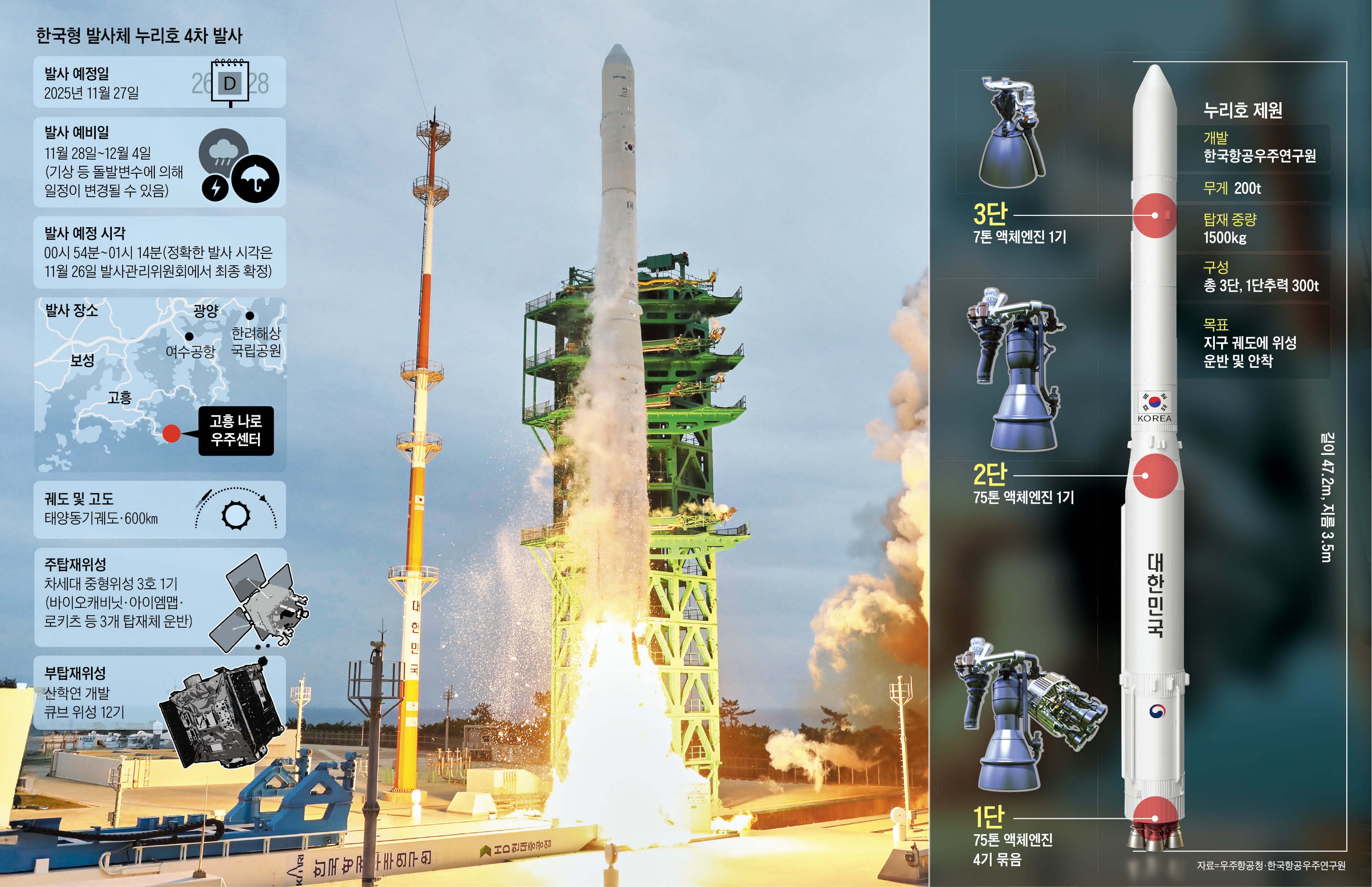
South Korea's first homegrown space launch vehicle, 'Nuri,' is set for its fourth mission in approximately ten days. The launch is planned for the early hours of the 27th. This marks its initial trip to space in two and a half years since the third launch.
This launch represents the first time a private company, Hanwha Aerospace, has taken the lead instead of the government. During the third launch, the Korea Aerospace Research Institute (KARI) was responsible for producing and assembling the Nuri rocket, with Hanwha playing a supporting role. However, this time, Hanwha has assumed control over almost all aspects—from manufacturing and assembly to operations—following technology transfers. Moreover, more than a dozen payloads developed by domestic industry, academic institutions, and research organizations will be sent into space on the fourth Nuri launch. This also increases expectations as it offers a chance to comprehensively test South Korea's space technology.
◇Nuri rocket set to launch at night for the first time
The fourth launch is anticipated to occur between 12:54 a.m. and 1:14 a.m. on the 27th. The precise launch time will be confirmed on the 26th. Nevertheless, there is a chance that the schedule may be altered because of unexpected factors like weather conditions. KARI has designated November 28 through December 4 as alternative launch dates.
The early morning launch is due to the primary payload, the Next-Generation Medium Satellite 3, which is designed to study auroras and atmospheric light while measuring cosmic magnetic fields. For this purpose, it must reach a sun-synchronous orbit at an altitude of 600 km. The Naro Space Center launch site is perfectly aligned with this orbital plane around 1 a.m. Han Young-min, head of KARI’s Space Launch Vehicle Research Institute, said, “To meet the unique orbit needed for aurora observation, the Nuri rocket is attempting a nighttime launch for the first time.”
◇13 satellites on board... The era of 'rocket delivery' begins
The fourth Nuri launch is also notable as it signifies South Korea's arrival in the 'New Space' era, driven by the private firm Hanwha. The system integrator will oversee the rocket's launch and, in doing so, assume responsibility for deploying multiple satellites that other companies, academic institutions, and organizations plan to send into space. This marks the beginning of the 'rocket delivery' era.
The satellites carried on the fourth Nuri launch are more varied compared to those in the previous one, leading to a higher overall payload weight. The main satellite, the Next-Generation Medium Satellite 3, was created by Korea Aerospace Industries (KAI). This primary satellite is equipped with different instruments to perform space experiments directly. This time, it will transport three payloads. The 'Bio-Cabinet,' developed by Hallym University, is expected to function as a mini-laboratory for producing human organs or tissues in 3D using stem cells in the microgravity of space. The 'IAMMAP,' developed by the KAIST Satellite Research Center, will also be on board. It is a device that measures how plasma (charged gas) in space influences radio waves, communications, and satellite orbits. The 'LokiSat,' developed by the Korea Astronomy and Space Science Institute, will also be included. It is a space camera designed to photograph auroras. Through this, it will study how solar activity affects Earth's atmosphere and communication systems.
The count of secondary satellites has risen from seven during the third launch to twelve in this one. Secondary satellites are small satellites that are launched together with the main satellite. All twelve were created by South Korean companies, universities, and organizations. The overall payload weight has doubled to 1,040 kg.
Among them, the 'ETRISat,' created by the Electronics and Telecommunications Research Institute (ETRI), will test technology for transmitting signals to space. In the ocean, there are sensor buoys known as 'buoys,' which gather information like sea water temperature and wave height. Once this data is sent to the ETRISat, the satellite will transmit the signal back to ground stations. Should this experiment be successful, it could allow for real-time tracking of various climate changes through satellites in the future.
The 'BEE-1000,' created by the local space pharmaceutical company 'Stayslin Tech,' will also be on board. It is a satellite designed to carry out experiments aimed at crystallizing the cancer treatment drug pembrolizumab in space. The experiment examines if protein crystals can be produced more uniformly and accurately in a microgravity setting. The objective is to advance the creation of quicker and more accurate new medications through research in space-based life sciences.
The 'COSMIC,' created by the space company 'Uzuro Tech,' is a satellite that features a 'self-disposal mechanism.' After three months, it will activate its internal disposal system to decrease its speed, lower its orbit, and ultimately be discarded. This process involves it descending into Earth's atmosphere and disintegrating due to air resistance. The objective is to remove space debris. Throughout this procedure, it will utilize software to make real-time adjustments to its movement, preventing collisions with other satellites or space debris as it descends toward Earth's atmosphere. This also helps in testing 'space traffic management' technology.
To effectively modify the orbits of heavier satellites in space, the high-efficiency satellite propellant 'hydrazine' will be utilized for the first time. It is also significant that the domestic research team has independently carried out the hydrazine fuel neutralization process without any external support. Han Young-min mentioned, “Satellites weighing more than 500 kg, including medium to large and small to medium sizes, are almost entirely powered by hydrazine. It provides strong thrust in space and ensures stable operation.”