
On Saturday, November 15, regional newspapers covered a range of social, political, and economic matters impacting Kenyans, with particular focus on the ODM party's 20th anniversary in Mombasa, highlighting increasing tensions, changing loyalties, and hopes for the festivities.
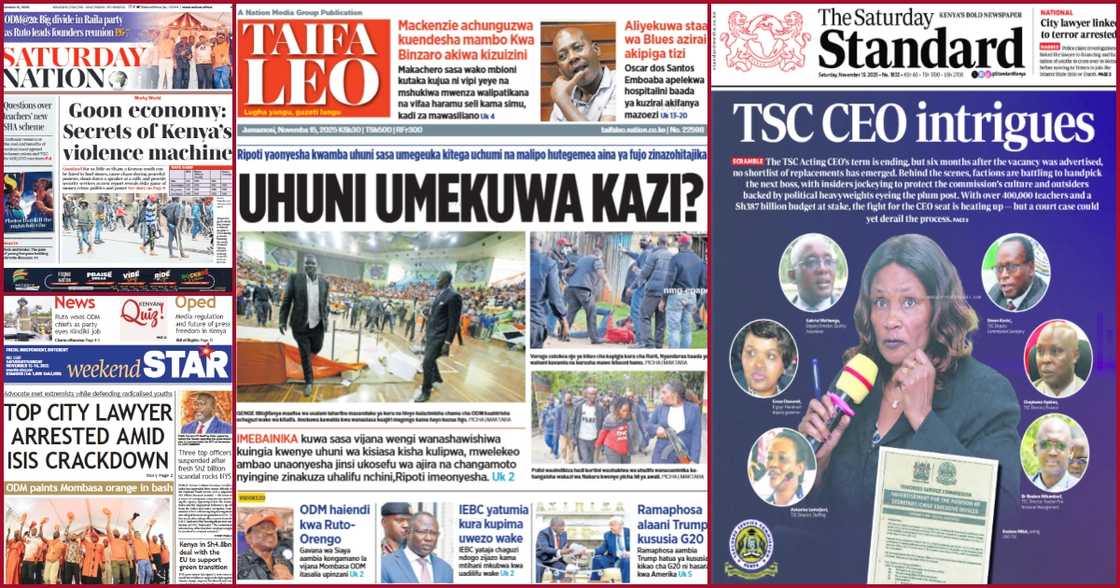
1. The Saturday Standard
As per the report, the Independent Electoral and Boundaries Commission called upon candidates in the Kasipul by election following allegations of violence during theby-electioncampaigns.
The head of the commission, Erastus Ethekon, informed reporters that the hearings will start on Monday, November 17, and cautioned that any candidate breaking the election rules could be disqualified.
The study stated that conflicts among opposing fans had already resulted in two fatalities.
The deceased, named Ben Ondiege and Bruno Onyango, both aged 26, sustained head trauma.
Law enforcement reported that gunfire occurred during the clashes, resulting in several people being seriously injured. Cars and campaign materials were also damaged.
The Orange Democratic Movement, which has put forward Boyd Were as its candidate, denounced the violence and blamed an opposing group for using paid thugs to interfere with gatherings.
The head of ODM, Gladys Wanga, was reported as stating that the party would keep campaigning in a peaceful manner and called on security forces to implement strong measures.
2. Saturday Nation
As per the report, arrangements are being made for a gathering of the remaining members of the influential ODM Pentagon, almost two decades after the group held significant sway over national politics.
President William Ruto, Prime Cabinet Secretary Musalia Mudavadi, and former Tourism Cabinet Secretary Najib Balala are set to gather at an event called the ODM Founders’ Dinner.
The event, set to take place today in Mombasa, will be included in the party's anniversary festivities and is seen as a move by Ruto and the ODM leadership led by Senator Oburu Oginga to build a coalition for the 2027 General Election.
The report stated that the Pentagon came into prominence during the 2005 referendum conflicts, as Raila Odinga brought together a group of regional leaders to form a noticeable opposition movement.
The group was organized to present ODM as a national entity during the 2007 elections, uniting Odinga, Ruto, Mr Mudavadi, the late Joe Nyaga, and Balala, with Charity Ngilu later becoming part of the team.
Balala and Ngilu were cited for mentioning Raila's capacity to develop a robust national movement and recognize emerging leaders.
Balala indicated that he was prepared to join the ODM anniversary event, whereas Ngilu mentioned the challenge of locating a leader of Raila's prominence.
The report mentioned that the Pentagon played a role in boosting ODM's 2007 efforts, although tensions increased within the alliance.
By 2013, the group disbanded, with Ruto aligning himself with Uhuru Kenyatta, Mudavadi pursuing an independent campaign, and Balala entering the Jubilee coalition.
3. Weekend Star
As stated in the report, long-time Raila Odinga advisor Dennis Onyango backed suggestions for a potential UDA-ODM alliance, contending that the opposition party did not have the ability to stage a viable presidential campaign by itself.
He mentioned that ODM needs to face political realities and acknowledge that its partnership with Ruto, spanning from 2025 to 2027, offers the party little room to effectively get ready for a significant presidential election.
The study stated that Onyango rejected the notion of ODM postponing its decision until 2027, arguing that such delay would put the party at risk of failure.
He contended that ODM must choose whether it plans to support Ruto or former vice president Rigathi Gachagua and start discussions promptly.
Onyango remembered a discussion where Raila mentioned he had collaborated with former leaders Daniel arap Moi, Mwai Kibaki, and Uhuru Kenyatta, and is now working with Ruto.
Raila reportedly characterized Ruto as the most determined among the four, which, according to Onyango, implied Raila believed there was a high chance of supporting Ruto.
"He mentioned that he believed Ruto was more focused than any of the presidents he had previously worked with, so there was a high chance he would support him (Ruto); he simply didn't want ODM to enter as a weak ally," he said.
4. Taifa Leo
According to the Swahili newspaper, fresh information has come to light in the legal dispute between the contentious pastor Paul Mackenzie and the Shimo la Tewa Prison authorities.
The religious leader's faction raised doubts about how he could have organized the Kwa Bi Nzaro attacks from within prison, and how mobile phones and SIM cards managed to get into his cell despite strict jail regulations.
Mackenzie, via his attorney Levin Obonyo, informed the court that he was worried about a potential threat to his life.
He claimed that following his return from a murder case at the High Court, he discovered his cell had been tampered with.
He stated he observed a powder-like material in his water bottle and fragments of glass close to his dining area, asserting that his ongoing detention put him at risk and breached his rights.
The prison authorities submitted paperwork that highlighted worries regarding security issues connected to Mackenzie.
A prison-based DCI officer, Abdiwilly Hassan, stated that a search took place on 20 September following reports that connected Mackenzie to the Kwa Bi Nzaro incident, during which over thirty bodies and human remains were found.
The Malindi Court had granted permission for investigators to examine the phone.
Law enforcement officials informed the court that they discovered two mobile devices, three SIM cards, and shaving razors inside the prison cells of Mackenzie and his fellow defendant, Francis Omondi.
Additional SIM cards and razors were found in the cells of their associates, named Smart Deri Mwakalama, Kelvin Sudi Asena, and Titus Munyao Musyoka. All objects were sent to the DCI laboratory for forensic examination.