
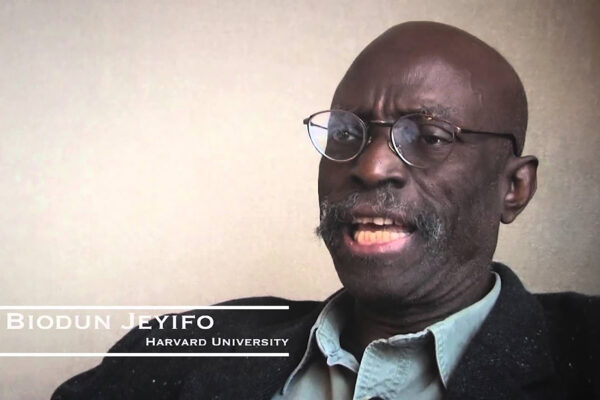
We mourn the passing of Prof Biodun Jeyifo, or BJ, as we affectionately knew him, last week, just a short time after we held an 80th birthday symposium in his honor. During the gathering, his close friend, Dr Yemi Ogunbiyi, shared that he was not expected to live to the age of 80, as he had been diagnosed with a condition that typically led to a much shorter lifespan. Because of this, he moved to the United States to gain access to improved healthcare. We are grateful to God for granting him a long and meaningful life.
I had known BJ as a young Marxist student at Ahmadu Bello University, Zaria, who often went to Ife to interact with the considerable number of student and lecturer comrades who thrived within the university's environment. I always regarded him as an inspiring individual fully dedicated to the cause of revolution. He enjoyed debates and was never afraid to engage in discussions, as he possessed a natural talent for speaking. BJ also did not hesitate to criticize the older generation of Marxists, whom he believed had not fulfilled their responsibility in guiding the nation towards the socialist future we all deserved.
I remember a meeting of Nigerian revolutionaries, a word we used to describe ourselves in those days, a big debate over who had the correct understanding of the social forces in the country and how to combat them and open a path for genuine revolutionary struggle. The meeting which took place in Jos was strongly marked by an age divide which crept up between BJ and Eddie Madunagu on the one hand and the older comrades on the important question of revolutionary capacity and strategy. As often happens in such situations, labels emerge to counter stronger arguments and BJ and Eddie were labelled with the 'insult' word of Trotskyites to delegitimise their arguments. Maybe one day, I will write about my recollections about labelling in Nigeria's left history- the Trotskyites, the labour aristocrats, the opportunists, the Stalinists, the Maoists, the suspected state agents and other false pretenders. It has been a significant baggage for left movements throughout history.
This is the reason why, despite over a century of organization, the left never managed to create a unified movement. The various conferences and movements, beginning with the Zikist Movement, which Zik himself criticized in the 1950s, followed by Tunji Otegbeye's Socialist Workers and Farmers Party in the 1960s, The Movement for People's Democracy (1975), All Nigeria Socialist Conference, Zaria (1977 and 1978), all failed to attain unity. The left has remained in a position where its goals were always clear—building a better life for the majority of our people by removing the ruling class, which lacks both the desire and ability to do so—but these efforts have continually struggled.

As a young lecturer at Ahmadu Bello University in 1980, I was already part of the progressive group when Biodun Jeyifo (BJ) and Uzodinma Nwala, newly elected first President and Secretary of ASUU, arrived at our Samaru campus to share the good news. The transformation had taken place, they announced, as per the 1978 law, the Nigerian Association of University Teachers, which was active in the five initial universities, was no more, and from its ashes emerged the Academic Staff Union of Universities (ASUU), a trade union. We were thrilled as BJ explained that intellectuals could now join the working-class movement as trade unionists and offer our intellectual support to the broader struggle to enhance the education system, but even more importantly, contribute to building a progressive Nigeria. We celebrated the irony that a repressive military regime inadvertently created favorable conditions for the revolution.
I was part of the group that quickly went to the Department of Electrical Engineering to notify Prof Buba Bajoga, the previous leader of the association, that a new administration had taken over and his association had been legally dissolved. As always, he remained a gentleman and accepted the new situation, moving forward. We arranged for elections, and George Kwanashie and Raufu Mustapha became the first leaders of ASUU at ABU, which was the center of campus activism in Nigeria. We immediately started organizing the first ASUU strike, and in 1982, I spent several months at the Ibadan headquarters supporting the ASUU negotiation team. In 1983, I took on the role of secretary of ASUU at ABU, with Yahaya Abdullahi as Chairman, and the struggle carried on.
BJ's main argument was that through a unified coordination of the organizational efforts of workers and intellectuals, a chance could arise for a revolutionary vanguard to develop and provide the essential drive for the Nigerian revolution, which had the potential to completely reshape the entire African continent. It should be remembered that prior to 'creating' ASUU from a law that universities were not even aware of, BJ and some of his colleagues had set up the Ogi commune in rural Osun State, where they collaborated with the peasants in an attempt to replicate the Maoist revolution in Nigeria. The commune did not succeed, and ASUU became the following step in their revolutionary journey.
The uprising did not take place at that time. BJ relocated to the United States, emerged as one of the world's most accomplished literary critics, and developed the poetics and aesthetics that supported the case for Wole Soyinka's Nobel Prize in Literature. Because of BJ's contributions, Soyinka received the honor and brought Nigeria into the literary spotlight. As BJ joins the ancestors, his legacy and debates continue to motivate revolutionaries and others who possess the talent for eloquent speech.
Provided by zaianews.com.