
Historic Peace Agreement Between Armenia and Azerbaijan
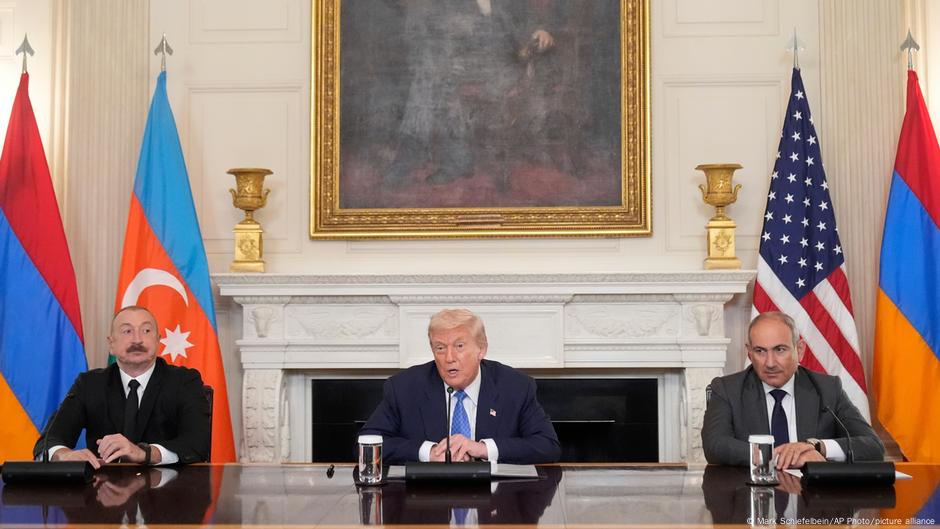
Armenia and Azerbaijan have taken a significant step toward ending decades of conflict by signing a historic peace agreement. The deal was signed in the presence of US President Donald Trump, marking a pivotal moment in the long-standing tensions between the two nations.
The agreement was formalized on Friday at the White House, where Armenian Prime Minister Nikol Pashinyan and Azerbaijani President Ilham Aliyev exchanged their signatures. This landmark event is expected to bring an end to nearly four decades of hostilities over the Nagorno-Karabakh region, located in southwestern Azerbaijan.
"Today we are writing a great new history," said Aliyev during a joint press conference with Trump and Pashinyan. He expressed gratitude for Trump's role in facilitating "peace" in the Caucasus region. Pashinyan also acknowledged the significance of the agreement, calling it a "success for our countries and for our region." He praised Trump for his leadership and efforts as a peacemaker.
Trump emphasized that all three leaders had engaged in an extensive discussion and signed "voluminous documents" related to the peace deal. He highlighted the transformation of the relationship between the two nations, stating, "It's a long time, 35 years, they fought and now they're friends, and they're going to be friends for a long time."
Background of the Conflict
The tensions between Armenia and Azerbaijan date back to the late 1980s when Nagorno-Karabakh, a mountainous region in Azerbaijan, declared independence with support from Armenia. This led to a protracted conflict that resulted in the displacement of thousands of people.
In 2023, Azerbaijan launched a military offensive to regain control of the region, which forced almost all of the remaining 100,000 ethnic Armenians to flee to Armenia. The recent peace agreement aims to address these issues by committing both nations to cease hostilities, establish diplomatic relations, and respect each other’s territorial integrity.
Key Elements of the Agreement
Although the exact wording of the agreement has not been released, one of its central components is the establishment of a trade and transit corridor through the South Caucasus. This route will be named after Trump and will connect Azerbaijan with its Nakhchivan exclave, which is separated by a 32-kilometer-wide strip of Armenian territory.
The United States has been granted exclusive development rights to this transit corridor, which the White House claims will enhance regional exports of energy and other resources. This aspect of the deal had previously stalled peace negotiations, as Azerbaijan sought a viable transit route to Nakhchivan.
Additionally, the two nations were set to sign a letter requesting the dissolution of the Minsk Group, a mediation body under the Organization for Security and Cooperation in Europe that had been involved in the Nagorno-Karabakh dispute.
Geopolitical Implications
The agreement represents a major shift in the geopolitical landscape of the South Caucasus. Russia, which had long played a dominant role in the region, has seen its influence wane in recent years. This decline has been exacerbated by Russia’s ongoing conflict with Ukraine, which has diverted its attention and resources away from the Caucasus.
Both Armenian and Azerbaijani leaders have publicly recognized Trump's role in brokering the peace deal. They have even expressed their intention to nominate him for the Nobel Peace Prize. This sentiment echoes similar gestures from other world leaders, such as Cambodian Prime Minister Hun Manet and Israeli Prime Minister Benjamin Netanyahu, who also nominated Trump for the award.
A New Era of Cooperation
The peace agreement marks the beginning of a new chapter for Armenia and Azerbaijan, offering hope for lasting stability in the region. As the two nations move forward, the focus will likely shift to implementing the terms of the deal and strengthening bilateral relations.
With the involvement of the United States and the weakening influence of Russia, the South Caucasus is entering a period of reconfiguration. The success of this agreement could serve as a model for resolving other conflicts in the region, highlighting the importance of diplomacy and international cooperation.