
A Revolution in the Cocoa Fields
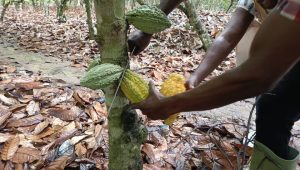
In the cocoa lands of Assin Fosu, located in the Central region of Ghana, a farmer named Mr. Samuel Torbi walks through his 17-acre farm with a machete in hand and purpose in stride. It is a drizzling afternoon, and beneath towering shade trees and carefully pruned cocoa pods, a quiet revolution is taking place—not through loud proclamations, but through coordinated cuts, traceable beans, and seasoned hands learning new techniques.
“We don’t wait for black pod to spread. We pluck and remove it early. We are taking measures to adapt,” Torbi says, pointing to cocoa beans on a wooden pallet. “That is how I get the produce I want.”
Ghana’s cocoa sector, long considered one of the pillars of the national economy, is now at the heart of a critical transformation. Farmers face challenges such as climate shocks, an aging labor force, strict traceability requirements, and volatile global markets. Yet, this period of change is also becoming a canvas for innovation. From digital tracking systems to hand pollination techniques, climate-smart practices to governance reforms, farmers like Mr. Torbi are not just surviving the change—they are leading it.
The Importance of Cocoa in Ghana
Ghana is not only the world’s second-largest cocoa producer after Côte d’Ivoire, but it also contributes nearly 15 percent of the global supply, according to the International Cocoa Organisation (ICCO). Over 800,000 farmers depend on the crop for their livelihoods, and cocoa accounts for a significant share of the country’s foreign exchange earnings, contributing almost 20 percent of Ghana’s export earnings. The stakes have never been higher.
To sustain its position as a major player in the global cocoa market, Ghana has begun implementing bold transformations grounded in climate-smart farming, traceability, and policy reforms. These efforts aim to make cocoa farming more sustainable, transparent, and rewarding for producers while eradicating child labor and bridging farmer realities with global standards.
Institutional Support Driving the Transition
This transformation is being driven by key institutions such as COCOBOD and its technical divisions, alongside development partners like the GIZ. During a recent field mission with journalists under the GIZ Sustainable Cocoa Programme media training initiative, it became evident that these organizations are playing a crucial role in sector-wide reform.
At the Cocoa Health and Extension Division (CHED) office in Assin Fosu, Mr. Abdul Rahman Ayiku Tetteh, Pruning and Cocoa Management Systems Coordinator, explained how the extension wing of COCOBOD is helping farmers adapt to changing climate and productivity pressures. “We are the first point of contact for any cocoa farmer. We assess lands, guide on suitable planting, and oversee seedlings,” he said.
Strengthening Resilience
With erratic rainfall, droughts, and El Niño effects disrupting production, CHED promotes pruning, mistletoe control, shade tree planting, and pest control through the Productivity Enhancement Programme (PEP). However, manpower limitations remain a challenge.
“Through targeted pruning programmes, shade management, pest control, and the introduction of climate-resilient varieties, we are preparing farmers to thrive amid climate variability… We are educating them not just to grow cocoa, but to manage cocoa farms as agribusinesses,” Mr. Tetteh said.
CHED is also scaling up hand pollination and climate-smart practices by training young people to assist aging farmers in delicate pollination work. Additionally, it uses the Cocoa-Centric Child Labour Monitoring System (CCCMS) to track and refer child labor cases to social welfare departments.
Quality and Traceability
Reforms go beyond production techniques. They include a digital overhaul of how cocoa is tracked and evaluated—a move seen as critical to meeting European Union traceability regulations and securing the country’s position in global markets.
At the Quality Control Company (QCC) office in Assin Fosu, Principal Quality Control Officer Yaw Asamoah noted that the country’s cocoa quality control is being digitized under the Ghana Cocoa Traceability System (GCTS). The system links each bag of cocoa to a specific farm, farmer, and purchasing clerk.
“Climate-smart cocoa isn’t just about growing. It’s about documentation, traceability, and transparency. If our beans don’t meet EU traceability rules, we risk losing market share,” Mr. Asamoah cautioned.
The GCTS pilot in Assin Fosu has over 40,000 mapped farms and more than 20,000 registered farmers, 40% of whom are women. Full nationwide rollout is underway to meet the European Union’s 2024 traceability mandate, which was extended to December 2025.
Farmer Voices and Grit
Farmers are not just beneficiaries of reform; they are active agents in reshaping cocoa production. In Assin Fosu, many have embraced practices that once seemed unfamiliar or unnecessary.
Mr. Torbi, who manages 36 acres in total, leads by example. “We begin with weeding, then pruning for ventilation. When we spot mistletoe, we cut and bury it. I have also planted over 20 shade trees this year to protect the cocoa from heat,” he said, encouraging other farmers to follow suit.
Recent reforms have also brought mixed reactions. On August 4, 2025, Finance Minister Dr. Cassiel Ato Forson announced a new cocoa producer price of GH¢3,228.75 per 64kg bag, equivalent to US$5,040 per tonne. This represents 70% of the Free-On-Board (FOB) value of US$7,200 and marks a 62.58% jump from last season’s dollar-denominated price of US$3,100.
Locally, the government is backing the increase with fresh reforms, including the reintroduction of free fertiliser, insecticides, fungicides, and spraying machines from the 2025/26 season. A tertiary education scholarship scheme for children of cocoa farmers is also slated to begin in 2026/27.
Debt Dilemma and Global Developments
Despite positive reforms, the sector faces a debt burden of over GH¢32 billion. Past forward contracts signed at lower prices have led to huge losses. The 2025 mid-year budget outlines a shift: COCOBOD will no longer fund road projects or engage in quasi-fiscal activities, allowing the organization to refocus on core tasks like extension services, yield improvement, and farmer welfare.
Globally, cocoa prices reached historic highs in early 2025—futures peaking above US$11,000 per tonne in both London and New York in January amid widespread crop failures in Ghana and Côte d’Ivoire, which account for more than 60 percent of global supply. As of the beginning of August 2025, spot prices have eased to around US$8,100–8,300 per tonne, still far above historical norms.
Road Ahead
Ghana’s cocoa sector is at a pivotal point. The government is optimistic, and the climate is changing. The rules of global trade are shifting, but within these changes lie opportunities to build a more resilient, transparent, and equitable cocoa industry.
Farmers like Mr. Torbi are already proving what’s possible. “Cocoa changed my life. I have built houses with cocoa. My children are in university. I want to leave them a farm that works,” he said.
From remote Assin Fosu to global chocolate shelves, the future is not being dictated—it is being dug, pruned, traced, and reimagined, one bean after the other with every farmer’s fingerprint on it.