
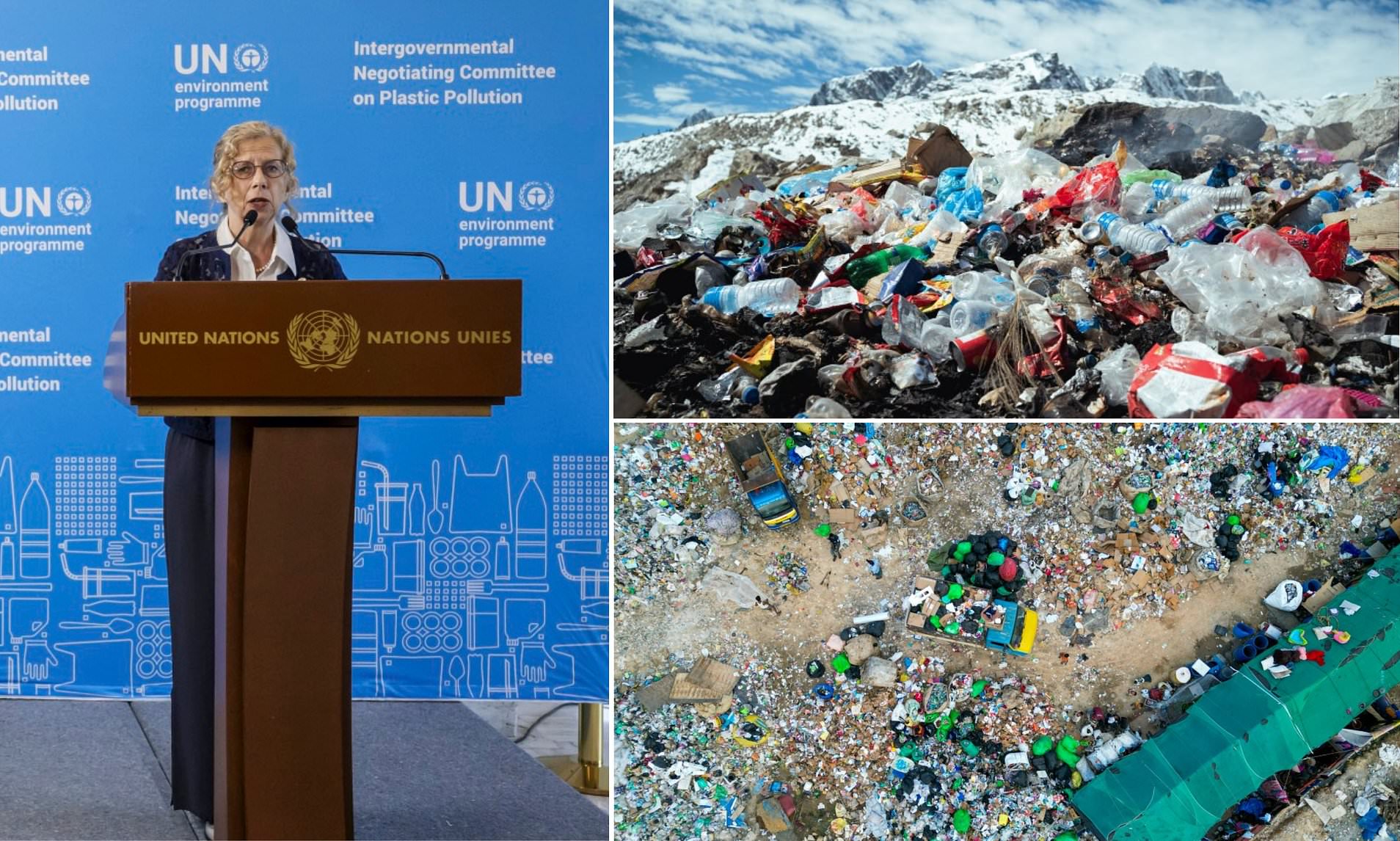
The Collapse of Global Plastic Pollution Talks
The recent negotiations aimed at creating a major international treaty to combat the escalating issue of plastic pollution ended without any agreement, marking a significant setback in global efforts to address this environmental crisis. Delegates from around the world met in Switzerland, but they left without a clear plan or immediate intention to resume discussions.
This failure is particularly concerning because it leaves no defined strategy for nations to collectively tackle the growing problem of plastic waste. Mountains of plastic are filling landfills, clogging oceans, and appearing on beaches and other public spaces. As Bjorn Beeler, international coordinator for the International Pollutants Elimination Network, stated upon adjournment, "Consensus is dead."
Every year, over 400 million tons of new plastic are produced globally, with projections suggesting a 70% increase by 2040 if current policies remain unchanged. Approximately 100 countries have expressed a desire to limit plastic production, while many others emphasize the importance of addressing the toxic chemicals used in its creation.
The final decision, or lack thereof, highlighted the influence of powerful oil-producing nations such as the United States and Saudi Arabia, which opposed any restrictions on plastic production. These countries, which rely heavily on oil and gas for their economies, were resistant to measures that could impact their industries.
Over 11 days, delegates gathered at the United Nations office in Geneva to discuss the treaty. However, they remained deadlocked on whether the treaty should aim to reduce the exponential growth of plastic production and implement legally binding controls on toxic chemicals used in its manufacturing.
Environmentalists, waste pickers, Indigenous leaders, and business executives traveled to the talks to voice their concerns. Indigenous leaders specifically advocated for a treaty that recognizes their rights and traditional knowledge. Meanwhile, the Youth Plastic Action Network was the only organization that spoke during the closing meeting. Observers' comments were cut off at the request of the US and Kuwait after 24 hours of meetings and negotiations.
Despite the disappointing outcome, some delegates tried to maintain a positive outlook, expressing hope for future discussions. They agreed to meet again at some point in the future. Inger Andersen, executive director of the United Nations Environment Programme, acknowledged the challenges and disappointment but emphasized that significant progress had been made.
The process will not stop, she said, although it remains uncertain how long it will take to finalize a treaty now. The negotiations were intended to be the last round and produce the first legally binding treaty on plastic pollution, including in the oceans. However, similar to the meeting in South Korea last year, the talks ended without an agreement.
Luis Vayas Valdivieso, chair of the negotiating committee, presented two drafts of treaty text based on the views of the nations. However, representatives from 184 countries did not agree to use either draft as a basis for further negotiations. Valdivieso noted that no further action was being proposed on the latest draft during the final meeting.
After a three-hour session, he concluded the meeting by banging a gavel made from recycled plastic bottle tops from a Nairobi landfill—a symbol of the plastic problem that was visible throughout the talks.
European Commissioner Jessika Roswall expressed that the European Union and its member states had higher expectations for this meeting. While the draft fell short of their demands, she considered it a good basis for future negotiations. "The Earth is not ours only. We are stewards for those who come after us. Let us fulfill that duty," she said.
Representatives from Norway, Australia, Tuvalu, and other nations expressed deep disappointment at leaving Geneva without a treaty. Madagascar's representative stated that the world is "expecting action, not reports from us." China's delegation described the fight against plastic pollution as a long marathon, viewing the temporary setback as a new starting point to forge consensus.
For any proposal to be included in the treaty, every nation must agree. India, Saudi Arabia, Iran, Kuwait, Vietnam, and others have stressed the importance of consensus for an effective treaty. Some countries have suggested changing the process so decisions can be made by vote if necessary.
Graham Forbes, head of the Greenpeace delegation in Geneva, urged delegates to consider this direction. "We are going in circles. We cannot continue to do the same thing and expect a different result," he said as the meeting ended.
The primary issue during the talks was whether the treaty should impose caps on producing new plastic or focus on improving design, recycling, and reuse. Saudi Arabia, Kuwait, and the US opposed cutting plastic production or banning chemical additives in the treaty. The US supported provisions to improve waste collection and management, product design, and recycling efforts.
Saudi Arabia criticized both drafts for lacking balance, stating that the latest proposal gave more weight to other nations' views. The draft did not include a limit on plastic production but recognized that current levels are "unsustainable" and require global action.
New language was added to indicate that current levels of production and consumption exceed waste management capacities and are expected to increase further, necessitating a coordinated global response. The treaty's objective was revised to reflect a comprehensive approach addressing the full lifecycle of plastics.
It also mentioned reducing plastic products containing harmful chemicals and single-use or short-lived plastic products. While this was a more ambitious text, it was not perfect. Magnus Heunicke, the Danish environment minister, noted that each country came to Geneva with "red lines," emphasizing that compromise requires bending these lines.