
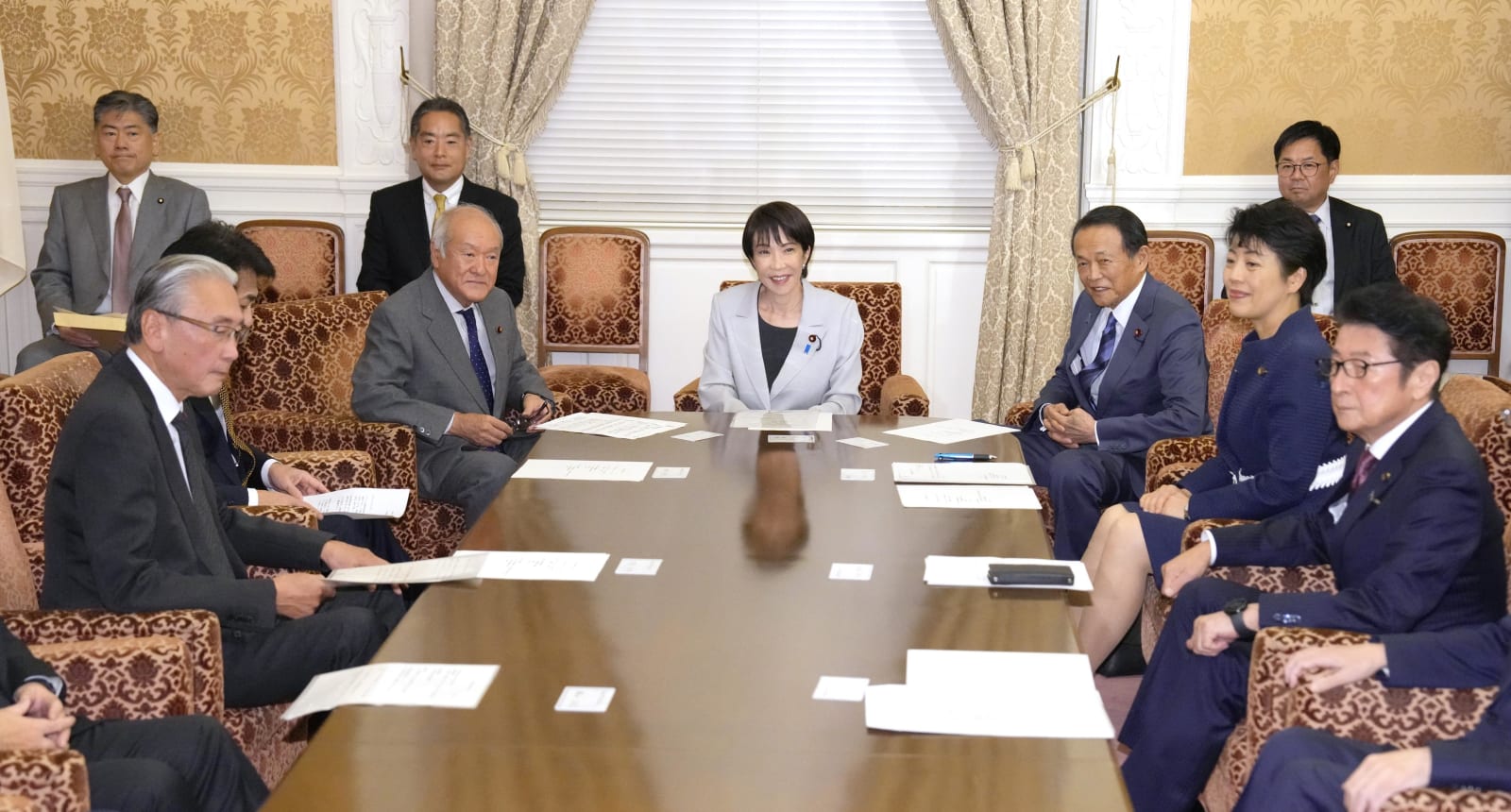
TOKYO - The ruling Liberal Democratic Party of Japan celebrated the 70th anniversary of its establishment on Saturday, while worries persist that reforms following a political funding scandal may face delays, as Prime Minister Sanae Takaichi gains increasing public support.
Takaichi, Japan's inaugural female prime minister, has begun her tenure strongly since assuming office on October 21, as the LDP has altered its coalition partner for the first time in more than two decades, and she has skillfully managed several important diplomatic missions.
Political analysts suggest that the 64-year-old leader, recognized for her strong views on security, should lead efforts to reform both the LDP and Japan's political structure, including regulations on campaign funding, in order to rebuild public confidence in politics.
The conservative LDP has been in power almost non-stop since its establishment in 1955, although its governing coalition currently does not have a majority in either house of parliament, as the party's secret fund scandal has made voters much less inclined to back it.
Following Takaichi's victory in the Oct. 4 presidential election, which came after her predecessor Shigeru Ishiba announced his resignation, the centrist Komeito party chose to terminate its 26-year alliance with the LDP.
Certain opposition groups looked for methods to gain control, but Takaichi managed to become prime minister once the LDP formed a coalition with the Japan Innovation Party, obtaining almost half of the seats in the more influential House of Representatives.
Takaichi's government has maintained strong public support, according to a Kyodo News poll indicating 64.4 percent approval in late October, with certain media reports suggesting figures above 70 percent, significantly surpassing the levels seen during the early phases of her predecessors Ishiba and Fumio Kishida's leadership.
Masahiro Iwasaki, a political science professor at Nihon University, stated, "To put it simply, a feeling of renewal could be the explanation," in reference to the rise of the first female leader and a new group of political alliances.
He also remarked that Takaichi "performed well" during a set of bilateral summits in October, including her meeting with U.S. President Donald Trump in Tokyo and individual discussions with Chinese President Xi Jinping and South Korean President Lee Jae Myung during a regional event in his nation.
But Iwasaki sees her management of the slush fund scandal, which came to light in late 2023 and involved numerous senior LDP lawmakers, as an issue. This ultimately caused long-standing party factions to dissolve in order to take responsibility.
The controversy surrounding the misreporting of income from fundraising activities weakened the party, leading the previous governing faction to lose its majority in the lower house election held in October 2024 and during the House of Councillors vote in July.
In a report reviewing the July national election, the LDP stated that it had lost public confidence due to the scandal, pointing out that its legislators did not adequately clarify how and why they gathered and utilized unreported funds, while vowing to "begin anew."
Nevertheless, Takaichi assigned multiple LDP legislators involved in the scandal to important government and party positions, stating that some of them had secured victories in recent elections. This marked a shift from the approach taken by Kishida and Ishiba, leading to criticism from opposition parties.
Among those appointed are Koichi Hagiuda, who serves as the acting LDP secretary general, and Kei Sato, who is the deputy chief of the Cabinet secretariat. Hagiuda was previously a key advisor to former Prime Minister Shinzo Abe, who was killed in 2022.
Takaichi, who is also seen as a potential successor to Abe, does not perceive any issue with her appointments, whereas Iwasaki mentioned that the decision could provide critics with "ammunition" for attacks if she does not achieve noticeable results in the future.
Due to the scandal, all LDP factions dissolved except the one headed by former Prime Minister Taro Aso, 85, who continues to hold power within the party and played a key role in securing Takaichi's win in the LDP leadership election. She named him as vice president.
"Under Takaichi's leadership, groups and legislators involved in the slush fund controversy have come back, so I question whether party reforms will progress," Iwasaki stated.
The specialists also emphasized that fundamentally transforming the political system is crucial, especially by enhancing the openness of political contributions, which are frequently criticized for influencing policy choices according to particular interests instead of banning them.
Professor Takashi Tomisaki from Komazawa University stated that the LDP should pass a bill aimed at amending the legislation governing political finances, which was introduced by certain opposition parties.
The legislation aims to restrict corporate and organizational political donations to party headquarters and prefectural branches, in an effort to increase transparency in financial flows and prevent hidden funding methods.
During a parliamentary debate in November, Takaichi did not explicitly state her position on the bill, stating that "careful discussions" are required as it might impact "freedom of political expression."
Tomisaki noted that the LDP's commitment to tackling the "structural issue" in the political funding regulation law, which led to the slush fund scandal, is still inadequate.
"I anticipate Prime Minister Takaichi will implement significant changes to avoid future issues," Tomisaki stated, as more voters now wish she can develop effective solutions to distinguish herself from the long-standing pattern of political funding scandals.