
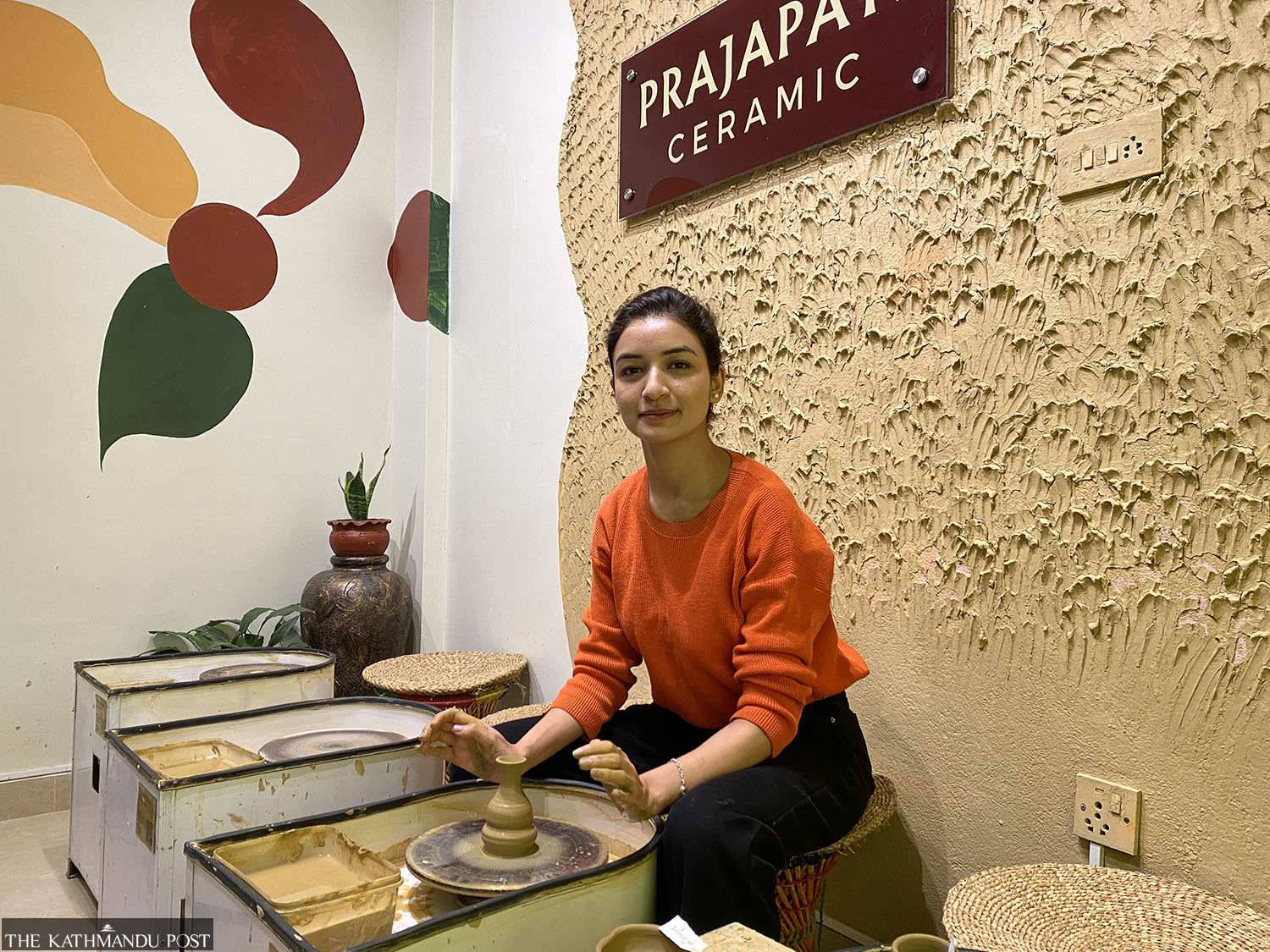
Kathmandu, November 10 -- At Prajapati Ceramic in Bauddha, ten pottery wheels are ready for imaginative hands; the walls are filled with mugs, small decorative plates, and bowls of different forms and dimensions, made by potters with varying degrees of expertise.
It was a completely unexpected idea, and I'm really glad I went through with it," says Riya Prajapati, the 22-year-old owner of Prajapati Ceramic, who claims "it is the first pottery studio in Kathmandu.
Prajapati first attempted pottery at the age of 19. Her uncle, who is involved in ceramics, showed her some techniques. "I didn't really understand it. I wasn't interested. I never imagined it would become such a significant part of my life."
However, pottery is "in her blood," as she states now. The Prajapati community has been involved in making and selling pottery and ceramics for many years. Riya's uncles are still engaged in the trade; her father, although a talented potter, took a different route. Before retiring, he worked with cars and motorcycles. Riya's mother is a beautician.
Following her initial attempts at pottery, she did not continue with the art. However, she changed her mind after coming across a call for submissions for the Lord Paul Enterprise Award at Herald College Kathmandu, where she is studying Computer Science. This competition offers an emerging entrepreneur from Nepal the opportunity to win a cash prize along with professional business guidance to support the growth of their business ideas.
I looked up on Google and found that there's no pottery studio in Kathmandu. There are a few in Patan and Bhaktapur, but nothing in the capital," she says. "This inspired me to start the first studio here.
Her idea: A place where she can merge the artistic heritage of her family with mental well-being. "Pottery is extremely calming—especially for those who spend a lot of time on electronic devices," says the young business owner. "Pottery teaches you to be patient. Instead of just focusing on the outcome, you remain present in the moment. It helps you set aside your worries, as you need to concentrate on what your hands are doing."
The concept existed, but there was still much progress needed. When Prajapati first applied for the business award, she didn't succeed. "I believe it was because of my poor communication abilities," she mentions. "I wasn't able to express my idea effectively."
But this did not deter her. In 2023, she established Prajapati Ceramic—back then, without a pottery studio or formal classes. The emphasis was on selling handcrafted Gautam Buddha statues made by her uncles. At the same time, Prajapati began sharing videos on social media about pottery and her uncles' craftsmanship. "I understand how crucial social media is for a business," she mentions. Meanwhile, her father taught her how to create pottery herself.
She continued to have faith in the potential of a pottery studio in Kathmandu. Eventually, she persuaded her parents to allow her to utilize their commercial space, which had once served as a restaurant. With assistance from her father, mother, and brother, she turned it into a warm and inviting studio.
In May 2024, after a second attempt, she received the Lord Paul Enterprise Award, along with £1,500 in prize money, which she used to purchase pottery wheels.
A month later, she received her first client—a woman who recognized her from TikTok. "I was anxious, I didn't know how to teach back then," Prajapati recalls. "But the more I taught, the better I became—also in pottery. Correcting the unstable designs of customers is the best way to improve."
The company is thriving. Each day, Prajapati receives customers from across the country and around the globe, spanning all age ranges. "We have travelers seeking an exciting activity or wishing to discover our artistic traditions, we have couples coming for a date, or children celebrating their birthdays here," she explains.
Several months ago, she and her family removed a wall to expand the area and accommodate additional pottery wheels. "We were closed for just one day during the renovation. On that day, ten people called us and showed interest in trying pottery. So we reopened and covered the construction site with a tarp," she says, laughing.
Prajapati also has ambitious visions for the future. She hopes to educate women to become pottery instructors, "I want them to have their own source of income and be able to work near their homes."
She believes that companies similar to hers can find a sustainable future in Nepal. "We have a large number of young individuals who are departing the country due to better prospects overseas," she explains. "However, it's crucial that we remain in our homeland and support our handicrafts." Her aspiration is to eventually establish additional studios in various locations.
I believe it's crucial not only to plan and dream but also to put our ideas into action," Prajapati states. "Excessive research can be tedious and depleting. My advice for those looking to launch a business: Simply begin.