
A Mysterious Discovery on Easter Island
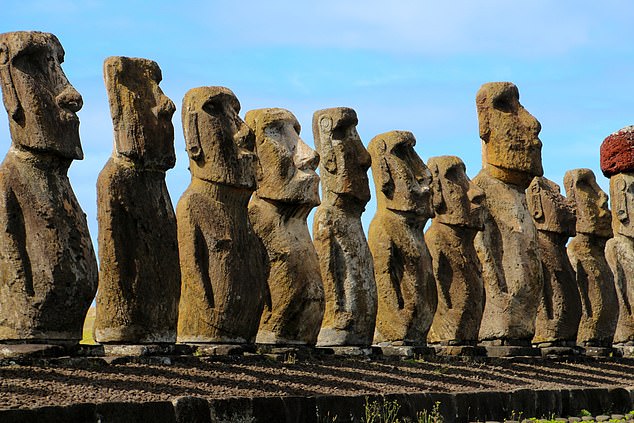
A recent discovery has stirred excitement among archaeologists and historians, as a new statue has emerged from the dried-up lakebed of Easter Island. This unexpected find has left scientists puzzled, as it was not previously known to exist. The island, famous for its 1,000 large stone heads called moai, has long been considered a mystery due to its rich cultural heritage and enigmatic history.
Terry Hunt, an archaeology professor at the University of Arizona, shared his thoughts with Good Morning America, stating that while they believed they had cataloged all the moai, this new discovery in the lake and at the statue quarry is a first. "There have been no moai found in the dry lakebed before, so this is a significant moment," he remarked.
The newly discovered moai is notably smaller than most, suggesting that more may be hidden within the reeds surrounding the area. Each moai honors a person, typically a leader, and many are adorned with eye stones. The largest of these statues stands over 30 feet tall and weighs up to 86 tons, showcasing the incredible craftsmanship of the ancient Rapa Nui people.
Salvador Atan Hito, vice president of Ma'u Henua, the Indigenous group managing the island's national park, emphasized the importance of this discovery for the Rapa Nui people. "For us, this is a very important discovery because it's here in the lake and nobody knew it existed, even our ancestors didn't know about this one," he said.
Hunt and Hito believe that the current dry conditions may allow for more discoveries. "Under the dry conditions that we have now, we may find more," Hunt explained. He noted that the tall reeds growing in the lakebed have been concealing these statues, but with the right technology, such as ground-penetrating radar, more could be uncovered. "When there's one moai in the lake, there's probably more."
Easter Island has traditionally been viewed as socially and culturally isolated from the wider Pacific world. This perception is reinforced by the fact that the iconic Moai statues, estimated to have been built between AD 1250 and 1500, are unique to the island. However, recent studies challenge this notion, suggesting that the island was not as isolated as previously thought.
For the past decade, Hunt and his team have been creating an inventory of 981 moai on the island, complete with GPS locations and measurements. Many of these statues remain in the quarry near Rano Raraku, the now-dry crater lake where the newest statue was found. The largest, known as Te Tokanga or 'The Giant,' was never completed and lies on its back, measuring 63 feet long and weighing an estimated 90 to 100 tons.
In 2023, the team made another significant discovery, finding a new moai that measured five feet by six inches long and was found face up in the ground. Hunt noted that the statue's eye sockets had been carved, which is historically the final step in a moai's construction. The base is also flat, designed to facilitate movement.
Researchers believe that the ancient Rapa Nui people likely moved the moai by "walking" them upright using ropes to rock and pivot the statues forward in a controlled motion. This method, supported by experiments and oral traditions, allowed them to transport these massive statues across the island without dragging them on sleds or rollers.
Hunt frequently uses cell phones and drones for 3D imaging of the moai. He is also exploring the use of ground-penetrating radar to detect hidden moai or structures underground, particularly in the Rano Raraku lakebed.
Historically, the original inhabitants of Easter Island, the Rapa Nui, were believed to have been completely isolated from the wider world. However, a study released in July by researchers in Sweden challenged this narrative. They suggested that the 63.2-square-mile island was not as isolated over the past 800 years as previously thought.
The study indicated that the island was populated by multiple waves of new inhabitants who bravely traversed the Pacific Ocean from west to east. According to Professor Paul Wallin at Uppsala University, "Easter Island was settled from central East Polynesia around AD 1200-1250." He added that the Polynesians were skilled sailors, using double canoes for their journeys.
The team at Uppsala University compared archaeological data and radiocarbon dates from settlements, ritual spaces, and monuments across Polynesia. They pointed out that ahu stone platforms, historically constructed at Polynesian islands further to the west, were communal ritual spaces that remain sacred in some places today.
The experts argue that Easter Island was populated several times by new seafarers, challenging the previous assumption of a single, isolated group. They suggest that the migration process from West Polynesian core areas to East Polynesia is not disputed, but the idea of a static west-to-east colonization and the isolation of Easter Island is being reconsidered.
Based on their evidence, the researchers also think that ahu originated on Easter Island before spreading east to west across other western Polynesian islands during the period of AD 1300-1600. It was only after this that the Polynesian islands, including but not limited to Easter Island, might have become isolated from each other.