
A-Level Results Day 2025: Record Highs and Regional Disparities
In a year marked by record-breaking results, students across the UK celebrated their A-level achievements, with many schools and regions reporting significant improvements. Among the standout performers was Brampton Manor in East Ham, London, a state school located in one of the city’s most disadvantaged areas. This institution achieved its best-ever results, with 250 students securing straight A grades. Over half of the pupils at Brampton Manor earned A* or A grades, with numerous students gaining admission to prestigious universities such as Oxford, Cambridge, Imperial, and UCL.
Brampton Manor has gained recognition for sending more students to Oxbridge than Eton College, with over 400 pupils admitted since its sixth form opened in 2012. One of its top achievers, Mate-Stefan Berghes, secured four A*s and will study Engineering Science at the University of Oxford. The school is also ranked as the world’s top school for Oxbridge entry, having sent 85 pupils to these institutions in 2022, up from 57 in 2021 and 53 in 2020.
Many of the high achievers at Brampton Manor come from ethnic minority backgrounds, are eligible for free school meals, or are the first in their families to attend university. These students joined thousands of others celebrating their results, which marked the highest proportion of top grades outside of the pandemic years.
National Trends and Regional Performance
Across the UK, 28.3% of A-level entries received an A or A, a slight increase from 27.8% in 2024 and above the 25.4% recorded in 2019. This marks the highest proportion of top grades since the pandemic, when grades were inflated due to teacher assessments. Additionally, 9.4% of entries received an A, up from 9.3% last year and 7.7% in 2019, setting another non-pandemic record.
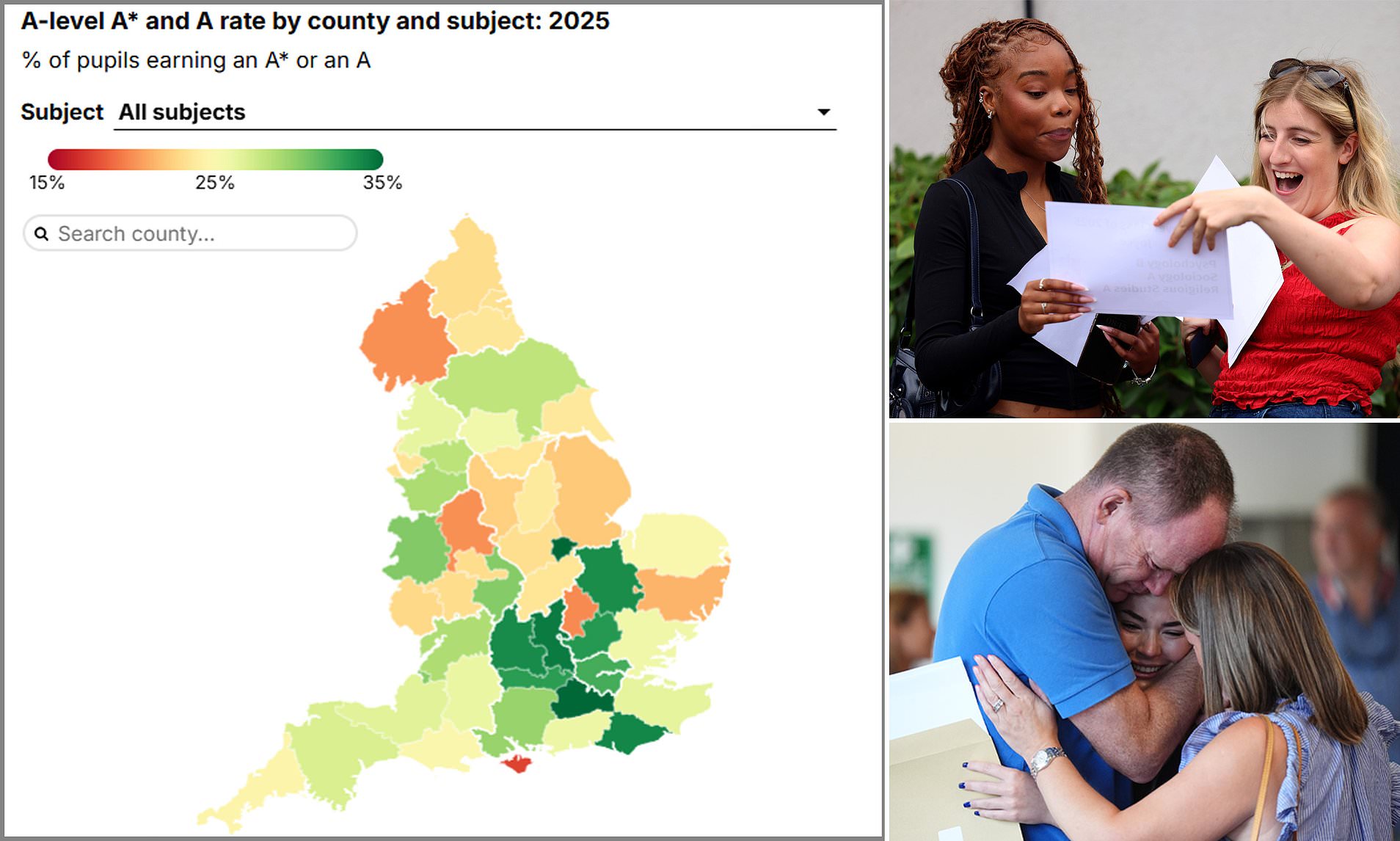
The overall pass rate (grades A to E) reached 97.5%, up from 97.2% in 2024 but slightly below the pre-pandemic figure of 97.6% in 2019. London saw the highest proportion of A or A grades at 32.1%, while the North East had the lowest at 22.9%. The gap between these two regions now stands at 9.2 percentage points, the largest since the grading system was introduced in 2010.
Northern Ireland reported the highest percentage of A or A grades at 30.4%, followed by Wales at 29.5% and England at 28.2%. Boys outperformed girls in terms of top grades for the first time in seven years, with 28.4% of boys’ entries achieving A or A compared to 28.2% for girls.
Popular Subjects and Educational Trends
Maths remained the most popular A-level subject for the 12th consecutive year, with 112,138 entries, a 4.4% increase from 2024. Psychology retained second place with 75,943 entries, down 3.3% from the previous year. Biology was third with 71,400 entries, a 4% decrease. Business studies made its debut in the top five, replacing history, while physics moved up to sixth place.
A total of 882,509 A-levels were awarded this year, a slight decline from 886,514 in 2024. Despite this, the overall pass rate rose to 97.5%, reflecting the continued success of students.
Ofqual, the UK's exams regulator, noted that the standard required to achieve grades has remained consistent since 2023. However, some experts argue that the current cohort is smaller and more academically capable, leading to higher results. Professor Alan Smithers of Buckingham University highlighted concerns about potential grade inflation, noting that the number of A*/A grades has increased despite expectations of a return to pre-pandemic standards.
Regional Inequalities and Social Factors
Regional disparities in A-level performance remain a pressing issue, with London consistently outperforming other regions. The gap between London and the North East has widened, raising concerns about the long-term impact of the pandemic on education. Schools in the North East saw a drop in top grades, with 22.9% of entries receiving A or A*, down from 23.9% in 2024.
Social and economic factors have also played a role in educational outcomes. Students from disadvantaged backgrounds often face greater challenges in accessing quality education, with some lacking digital devices or quiet study spaces during remote learning. These inequalities have contributed to the persistent divide in exam results between different regions.
Gender and Subject Choices
Gender differences in subject choices continue to shape A-level trends. Maths remains overwhelmingly male-dominated, with 70,255 boys’ entries compared to 41,883 girls’ entries. While both numbers have increased, the gender gap persists. Experts suggest that social media influencers may be influencing interest in subjects like economics and business studies, which are gaining popularity among students seeking entrepreneurial opportunities.
Business studies entered the top five most popular A-level subjects for the first time, reflecting a growing interest in practical, real-world applications of education. Claire Thomson of AQA noted that these subjects provide valuable skills in critical thinking, problem-solving, and data analysis, opening doors to a wide range of career paths.
University Admissions and Future Prospects
University admissions figures show a positive trend, with 255,130 UK applicants accepted onto courses this year—up 4.7% from 2024. International student numbers also rose, with 52,640 accepted, including a 13% increase from China. Ucas chief Jo Saxton emphasized the importance of supporting students who may not have met their expected grades, highlighting the availability of clearing options and expert guidance.
Education Secretary Bridget Phillipson acknowledged the progress made in stabilizing the education system after the pandemic. She stressed the need to address generational inequalities, particularly for disadvantaged students, through targeted policies and early years interventions.
Scotland’s Results and Comparative Insights
Scotland, which uses a different qualification system, also reported improved results. 78.4% of National 5 exam takers passed with A to C grades, up from 77.2% in 2024. For Highers, 75.9% achieved top bands, and 76.7% of Advanced Higher students scored A to C, showing steady improvement across all levels.