
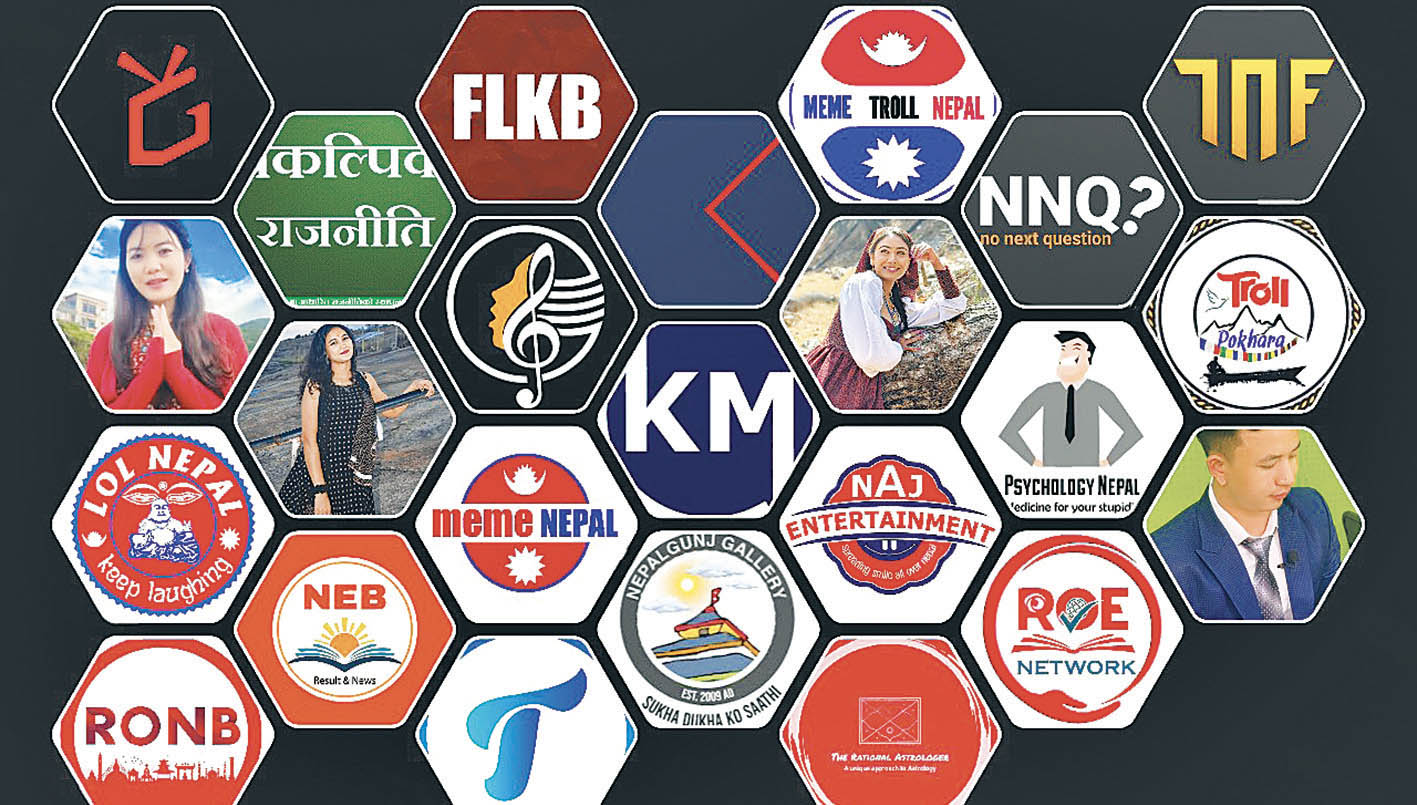
Kathmandu, February 23 – A study by The Kathmandu Post reveals that in the month leading up to Nepal's parliamentary elections, prominent Facebook pages with a total of six million followers focused significantly more on one political party than all others combined.
The Post analyzed 4,754 posts published between December 23, 2025, and January 22, 2026, from 24 Facebook pages that have hundreds of thousands to several million followers. Out of these posts, 2,447 contained political content. Content from the Rastriya Swatantra Party (RSP) was found in 1,324 posts (54.1% of the political posts)—nearly nine times more than the Nepali Congress and more than twice as much as the combined total of the Nepali Congress and the Communist Party Nepal (UML).
The pages—unconnected to any political party—include popular social media accounts such as 'Routine of Nepal Banda,' as well as regional pages like 'Troll Pokhara' (with 725,000 followers) and 'Nepalgunj Gallery' (with 178,000 followers). These mainly share a mix of content: local news, educational material, comedy, parody, and entertainment.
The study highlights a significant imbalance in how one political party dominates the content during Nepal's election period. It is still uncertain whether this is due to a planned approach, natural excitement, or an algorithmic inclination towards emotionally charged material. The data clearly demonstrates that content supporting the RSP, its leaders Balendra Shah and Rabi Lamichhane, and the party's blue bell emblem significantly surpasses coverage of the two long-standing parties that have ruled Nepal for many years. Furthermore, nearly all the material examined by the Post emphasizes personal and emotional visuals, while neglecting discussions on policy issues.
Another notable aspect of this election season is that conventional indicators of campaign effectiveness—such as the size of rallies, in-person outreach, and policy documents—might be less significant than mastering social media platforms, where millions of Nepalis now obtain their information, which they perceive as factual news.

The 24 pages were chosen according to three factors: number of followers, level of engagement, and consistent posting. Only pages showing significant interaction via likes, comments, and shares, along with clearly active follower groups, were considered.
For every page, The Post examined the latest 200 posts and utilized AI-driven tools to assist in classifying material, recognizing recurring themes, and identifying political mentions. Posts were labeled as political if they mentioned parties, candidates, elections, or administration.
One moment... Please enable JavaScript and cookies to proceed
Posts that referred to RSP leaders, the bell symbol, or party messages were classified as RSP-related. The approach used in this analysis detects patterns in published material but does not establish intent, coordination, or whether page administrators are associated with political parties.
Out of 192 posts shared by the page 'Alternative for Nepal' throughout the research period, 181 (94 percent) contained political material. Among these political posts, roughly 60 percent centered on RSP, Balen Shah, or Rabi Lamichhane.
The page incorporated the bell emoji in many posts.
In the same way, 'Ktm Post' has 147,000 followers and has shared a total of 161 posts: 111 concerning RSP, 6 related to UML, 3 about Nepali Congress, 1 regarding other political groups, and 37 non-political entries.
A moment, please... Enable JavaScript and cookies to proceed
"The Nepali Favour," a page mainly dedicated to memes, shared 200 posts throughout the research period. Out of these, 135 (68 percent) dealt with political topics, featuring "Balen Shah" and "Rabi Lamichhane" as the main keywords. The bell emoji and mentions of "RSP," "candidacy announcement," and different campaign locations were frequently seen.
"Routine of Nepal Banda," which has almost 5 million followers, shared 200 posts between January 17 and 23. Out of these, 99 (49.5 percent) were related to politics. Among the political posts, content associated with RSP was the most common, with "Balen Shah," "Rabi Lamichhane," and "RSP youth candidates" being the most frequently used keywords. In comparison, Nepali Congress was mentioned in 11 posts (5.5 percent), UML in 10 posts (5 percent), and NCP in 4 posts (2 percent).
At this moment, emotions are running high," stated Dovan Rai, a technologist specializing in behavior and managing R&D at Body & Data, a digital research company. "Individuals are making choices driven by their instincts, which are then intensified by algorithms.
Rai likenesses algorithms to traders who "gain a sort of instinct from data" and "promote whatever is popular or trends more forcefully."
Evidence backs up this finding. Investigations into Facebook's algorithm reveal that material causing intense emotional responses—especially anger, motivation, or worry—gets more visibility compared to neutral content.
In 2021, whistleblower Frances Haugen revealed internal Facebook documents, which exposed that the company's research indicated its algorithm favors content that elicits "angry" responses, resulting in increased "divisiveness and polarization," according to the Wall Street Journal's Facebook Files investigation published in September 2021.
A moment, please... Enable JavaScript and cookies to proceed
The approach the Post discovered in Nepal aligns with results from elections around the world. Studies examining Facebook's involvement in elections in the Philippines, India, and Myanmar revealed how content centered on personalities and emotional appeals consistently outperforms material focused on policies. In Myanmar, UN investigators determined that Facebook's algorithm helped spread hate speech and false information that fueled violence against Rohingya Muslims, prompting the company to admit in 2018 that it had not done enough to stop its platform from being used to "promote division and incite real-world violence."
The Post's analysis did not center on hate speech. Rather, it highlighted emotional stories: leaders visiting hospitals, meeting with bereaved families, and being surrounded by supporters. The content steered clear of policy debates, opting instead for personal anecdotes and symbolic visuals—exactly the kind of material that Facebook's algorithm, as per extensive studies, is built to promote. Several posts included AI-created images of RSP leaders.
When journalist Dinesh Sitaula, who had been traveling with RSP candidate Balendra Shah during his Achham visit, passed away on February 1, several pages quickly shared images that seemed to show Shah in grief. At 6:06 pm, one page showed Shah paying respects. An hour later, another image displayed him standing by a funeral fire, visibly upset. An hour after that, a third photo illustrated Shah and RSP President Rabi Lamichhane placing floral garlands on a corpse during the funeral ceremony.
Although all three images already clearly appear to be artificial, the Post subjected them to Hive Moderation, an AI detection system, and each of the three displayed a 99.9% probability of being created by AI.
Likewise, on January 15, the page 'Miss Pabi 41' (with 95,000 followers) shared a picture depicting well-known YouTuber Bhojraj Thapa hospitalized and unwell, with Lamichhane by his side, hands folded, seemingly in tears, while Shah was holding Thapa's hand. The caption stated, "Rabi and Balen arrived early in the morning to visit Bhojraj Thapa." "Everyone, please write 'Get Well Soon.'"
The message received hundreds of comments, with many saying "Get Well Soon." That picture was also created using artificial intelligence.
Several pages also spread verifiable false information, such as AI-created images and incorrect assertions that the president of the Nepali Congress, Gagan Kumar Thapa, had been detained, or that KP Sharma Oli, a leader of the CPN-UML and former prime minister, along with former home minister Ramesh Lekhak, had been placed under police custody. Additional posts depicted the public pursuing Pushpa Kamal Dahal, a leader of the Nepal Communist Party.
A moment, please... Enable JavaScript and cookies to proceed
Deepak Adhikari, a fact-checker and reporter who tracks online content, stated that he has noticed this trend. "These same pages are leading the spread of false information," he mentioned.
The most impactful page in the network, "Routine of Nepal Banda," has a background linked to RSP leader Balendra Shah, who is currently the party's nominee contesting against CPN-UML Chairman Oli in Jhapa-5.
On September 2, 2023, Shah, who was the mayor of Kathmandu at the time, shared a provocative message on Facebook following an incident where his wife's car was reportedly stopped by traffic officers for a standard inspection. "Let it go for today," Shah wrote. "However, if the government prevents KMC vehicles from moving starting tomorrow, I will set fire to Singha Durbar."
The next day, RONB sent congratulations to Shah upon the birth of his daughter. The platform faced accusations of posting the message in an attempt to shift attention away from the controversy surrounding Shah's violent threat to set fire to the government's administrative headquarters. As the criticism increased, RONB founder Victor Paudel declared that he would shut down the site. He brought it back online a few days later.
Despite prior allegations of political bias or sharing posts without context, it continues to stand firm, enjoying a significant young audience—many of whom back Shah's campaign and hope to see him defeat Oli in the fiercely competitive election in Jhapa.
On September 6, 2025, the Nepal Banda routine shared details regarding a vehicle striking a girl. The post stated: "Breaking news: In Harisiddhi, Lalitpur, a provincial minister's car hit a young child and then left the scene, causing the public to block the road since early morning."
Thirty-seven minutes later, a new update was shared. In reference to a picture of the then Prime Minister KP Sharma Oli, it stated: "When a vehicle collides with the public, leaders do not simply walk away, yet the prime minister describes it as 'normal' and dismisses it: Regarding the recent incident in Harisiddhi, Prime Minister KP Sharma Oli mentioned, 'A car typically hit a child. She has been taken to the hospital. There was no such intention.'"
Earlier this month, a four-year-old child passed away following a collision with a vehicle displaying an RSP sticker in Rautahat. RONB also shared a statement regarding that incident. "Heartbreaking news: A young girl was struck by a car while playing on the road in Rautahat and lost her life. Additional investigation is currently underway. Source: Rautahat District Police Office"
However, in contrast to the September incident, rather than publishing a new update in a separate post, it modified the original post to include additional details. Twenty-two minutes following the initial post, it was revised to add: "Further investigation is currently underway. Update: Upon contacting the District Police Office Rautahat, it was discovered that the vehicle involved in the accident was empty and displayed an RSP sticker, and the police have now detained the driver."
Precisely 50 minutes later, it was revised for the third time to state: "The driver has been taken into police custody."
The routine of Nepal Banda faced criticism for being less harsh in its coverage of an event linked to RSP, yet it expressed strong opinions when the event involved a different party.
RONB stated to the Post that allegations of selectively sharing content to support any candidate or party are false.
We do not filter the information we share and have not supported any group or individual," said Victor Paudel, founder of RONB. "The reason Balen's posts appear more prominent is due to their much higher level of interaction, whereas posts related to others receive less attention.
Not every page reviewed by the Post refrained from significant political discussion. 'KMAG Nepal', which states it shares "general news and updates on daily activities" and is registered under the name Lakshya Sapkota, shares material that clearly reflects a particular ideological perspective among its 103,000 followers. The account indicates that at least one of its administrators is located in Australia.
Out of 200 posts reviewed from January 1 to 22, 129 were directly connected to politics. These posts often addressed institutional reform, the rule of law, open market ideas, personal freedom, and educated voting. The page highlighted Gagan Thapa from Congress, depicting him as "the most reformist, liberal, and progressive leader in Nepali Congress" and "a person who can bring change within traditional parties, representing the younger generation."
Nevertheless, mentions of RSP and its leaders continued to be the main focus of the page's political material, with "Balen Shah" and "Rabi Lamichhane" being the most commonly referenced individuals.
None of the examined posts featured in-depth exploration of policy stances, party platforms, or evaluation of governance strategies.
Rather, the posts centered around individual narratives, emotional connections, and representational visuals. The bell emoji, RSP's election emblem, was featured on various pages, typically without direct political statements but in situations that linked the symbol to optimism, transformation, or renewal.
The Post did not find any proof that the two dozen pages are organized by RSP or operating under the party's guidance. None of the pages have revealed official ties to the party, and none of the page administrators are publicly associated with RSP.
Nevertheless, the widespread promotion of comparable messages on these pages brings up certain concerns: Is RSP gaining advantages from a natural network of supporters who voluntarily generate positive content? Does Facebook's algorithm merely prioritize emotional, character-based content that RSP's image represents? And is it possible for conventional political parties to keep up without implementing similar strategies?
Adhikari, a fact-checker and reporter, mentioned that a "battle of narratives" is taking place on social media via AI-created images and videos that might affect election results. "While there hasn't been a comprehensive study on this in Nepal, and it might be premature to reach definite conclusions, the approach and level of campaigning through social media is clearly on the rise," he stated.
Established political parties claim they are striving to adjust to the online environment, yet they have scarce funding and mainly rely on unpaid staff.
Min Bahadur Shahi, head of the UML's media division, stated that the party is concentrating on short-video content for younger voters. "Currently, we are creating TikTok and short-form videos to connect with the Gen Z group," he mentioned. "Our aim is to involve them in topics concerning anti-corruption and global rankings."
Shahi highlighted that UML's digital initiatives are natural. "Everything we are doing in the digital campaign is completely voluntary," he mentioned. "We do have friends who understand digital and social media, but they aren't a paid group. We haven't paid Meta, nor have we invested money in promoting any posts."
The Nepali Congress has a 15-member media team responsible for video editing and news writing, as stated by Jiban Bhandari, the Media Centre Coordinator. "Our focus is on content creation through the development of different photos, videos, and clips aligned with the party's objectives," Bhandari mentioned. The center gathers local news and shares it with media organizations across the country.
Our main emphasis is to transform the party's activities, strategies, and both previous and current efforts into content," he stated. "Regarding social media, our main concentration is on Facebook, although we also maintain a vibrant intellectual community on TikTok and X.
The Nepali Communist Party has focused on combating false information and content created by artificial intelligence, according to party representative Agni Sapkota. Similar to UML, NCP depends significantly on volunteers. "Many of our members are working without pay," Sapkota mentioned. "We compensate for the shortage of resources with dedication."
The difference between what traditional parties claim and what the Post's analysis reveals is notable. Although UML emphasizes "Gen Z" and Congress has a 15-member team, their content was featured in 19% of political posts across the analyzed pages—less than one-fifth of RSP's involvement.
RSP has established digital campaign committees at the central, constituency, and candidate levels to manage its online campaign, stated party spokesperson Manish Jha.
Two or three teams are operating from the center, while election mobilization committees have been established at the district level," Jha mentioned. "Candidates are also taking part. Those running under the first-past-the-post system are conducting large-scale campaigns, and those under proportional representation are also actively participating.
Jha mentioned that the party hasn't compensated any social media pages for promoting its content. "We haven't signed any agreements with well-known pages such as Routine of Nepal Banda to share our material," he stated. "Instead, they have backed us independently. No actions have been taken through official party procedures. Everything has been spontaneous, although there might have been some occasional suggestions."
When asked about the prevalence of emotionally intense material and AI-created false information in posts related to RSP, Jha stated that the party creates content that reflects public opinion but does not support misleading information.
This is part of campaign strategy. In a 360-degree campaign approach, there's a saying that goes, 'you can sell emotion without being emotional.' That is considered strategy," Jha stated. "We have not altered facts. We are operating within a specific framework.
Jha did not explicitly comment on the Post's discoveries regarding AI-created images depicting RSP leaders at events that never took place, nor on misleading posts asserting that opposing politicians had been detained.
It remains uncertain how much the social interaction and backing for a single party convert into actual votes during elections. The Post spoke with multiple voters in Kathmandu regarding their use of social media and sources of political information over the past few months.
Nirajan Khadka, a 48-year-old merchant from Anamnagar, has not reviewed any political party programs or attended candidate discussions. His views are shaped by spending many hours browsing Facebook each morning.
Renu is certain to triumph in Chitwan-3," he stated, forecasting the contest involving the daughter of Nepali Communist Party coordinator Dahal. "And Oli will suffer defeat in Jhapa-5.
Khadka is part of an expanding group of city-based voters who use social media to get political updates. "I typically look at horoscopes first thing in the morning and then read news from Nepal and around the globe," he mentioned. "Lately, it's been amusing to browse through the various tricks candidates use during their campaigns."
But he doesn't recognize diversity. "At times, there are images indicating a particular individual was arrested. At other times, pictures showing someone visited a hospital," he mentioned. "Perhaps because I frequently encounter such content, the same individuals keep appearing."
Prakash Bishwakarma, a 28-year-old hotel owner in Thapagaun, observes the same trend. "I do encounter candidates from other parties as well, but the majority I come across are from the 'bell' candidates," he mentioned, alluding to the RSP's election emblem. "To be honest, their content is also quite engaging."
For Purna Bahadur Basnet, a 56-year-old cosmetics shop owner, the disparity is bothersome. "These days, RSP candidates keep showing up on my feed and I wish there was a way to eliminate them," he mentioned.
The parent company of Facebook, Meta, has encountered increasing attention regarding the impact of its platform on elections worldwide, especially in nations outside the United States. By the end of 2024, a year marked by an unprecedented number of global elections, Meta stated that it has a specialized group focused on ensuring election integrity, comprising individuals from its intelligence, data science, engineering, research, content and public policy, and legal departments.
Meta mentioned in its statement that it operated several election operations centers globally to monitor and quickly address emerging issues, particularly during significant elections in the US, Bangladesh, Indonesia, India, Pakistan, the EU Parliament, France, the UK, South Africa, Mexico, and Brazil.
Experts have pointed out that Meta's efforts in monitoring elections are mainly focused on Western democracies and major markets, resulting in limited scrutiny for smaller nations such as Nepal.
The Election Commission of Nepal states that it has been actively observing social media sites for posts that breach the election code of conduct. Upon discovering such content, the commission officially contacts the appropriate authorities to request its deletion.
The commission suggests measures to the Cyber Bureau of Nepal Police and the Nepal Telecommunications Authority, after which the bureau contacts the relevant platforms or organizations to remove the identified content," stated Sita Pun Shrees, assistant spokesperson for the Election Commission.
As per Shrees, by February 20, the Cyber Bureau has suggested the deletion of 290 items of content shared on social media platforms. Out of these, 107 have been removed. The majority of the deleted material was posted on TikTok, whereas the number of Facebook posts removed is very low. Among the 24 pages reviewed by the Post, none had removed the contested content.
Shrees voiced her discontent with Meta's insufficient collaboration for the upcoming election. In the 2022 elections, she mentioned to the Post, the social media platform had established a special portal to help in reporting and removing content that breached the code of conduct. "This time, we haven't received the same amount of assistance," she stated. "We send them requests to remove certain content, but there is usually minimal response."
The main difficulty for authorities is recognizing people who manage Facebook accounts. "If we can determine the account owners or administrators, we can directly request them to delete the content," Shrees mentioned. "However, Meta has not been willing to assist us in locating the account holders."
The Post reached out to Meta four times between February 2 and February 20 through email, inquiring about Facebook's guidelines for political content during the Nepali elections, if it oversees coordinated inauthentic activities in Nepal, and if it has detected any breaches associated with these pages. Meta did not reply to our messages.
With less than a month until one of the most significant elections in the nation's history, voters like Khadka are not alone. Their morning scrolling habit has become the site of political contention. And in this arena, data reveals that one party's message is resonating more than any other.
zaianews.comWatch the Full Coverage